
Guideline 24.1 – Hyperkalaemia; Cardiac Arrest – Resuscitation strategy in haemodialysis patients
We recommend that standard ALS practice in cardiac arrest be applied to patients requiring dialysis. (1A)
Guideline 24.2 – Hyperkalaemia; Cardiac Arrest – Defibrillation practice in haemodialysis patients
We recommend disconnection from dialysis equipment prior to defibrillation unless the dialysis machine is defibrillator proof. (1C)
Rationale (Guidelines 24.1 – 24.2)
The risk of sudden cardiac death (SCD) is higher in patients receiving dialysis compared with the general population, non dialysis CKD 5 patients, and even patients with heart failure.1 Data from the USRDS database showed that compared with peritoneal dialysis, the rate of SCD is approximately 50% higher in HD patients 3 months after dialysis initiation.2 The initial approach to resuscitation in dialysis patients is similar to non dialysis patients, but there are some important considerations during CPR. It is also important to consider the incidence, potential aetiology of cardiac arrest, location and outcome in dialysis patients compared with the general population.
In hospital cardiac arrest (IHCA)
Annual data from the UK National Cardiac Arrest Audit (NCAA) between 2011 2021 found the incidence of IHCA ranged between 1 and 1.6 / 1000 hospital admissions.3,4 In comparison, the incidence of IHCA in the USA is 9.7 / 1000 hospital admissions.5 Survival at 30 days has been found to be higher after IHCA at 24% compared with OHCA at 17%.6
Little data is available on the incidence of IHCA in patients on long term HD, but survival does not appear to be consistently poor. Moss et al (1992) assessed the outcome of in hospital CPR in patients with ESRD showed a survival to hospital discharge of only 8%.7 In contrast, Wong et al (2015) reported a rate of 1.4 events per 1000 in hospital days with a survival to hospital discharge of 22%.8 Similarly, Saeed et al (2015) reported a 26% survival to hospital discharge after IHCA in longterm dialysis patients.9
Starks et al (2020) investigated the outcome of IHCA in longterm HD patients using the Get With The Guidelines Resuscitation registry.10 Although long term HD patients were less likely to have a shockable rhythm and less likely to have defibrillation within 2 minutes, they had similar adjusted odds of survival to discharge, better acute survival and were more likely to have a favourable neurological status compared with non dialysis patients.
Allencherril et al (2022) conducted a systematic review and meta analysis to assess the aetiology of IHCA and found that electrolyte disturbances was responsible for 3.01% of events.11 Interestingly, other causes with a similar frequency included cardiac tamponade (3.0%) and pulmonary embolism (2.66%). Therefore, the true incidence of electrolyte disorders may have been under estimated. Similarly, Penketh et al (2022) found that electrolyte disturbances accounted for 2% of IHCA and a similar rate for cardiac tamponade (2%) and pulmonary embolism (2%).12 Arrhythmias accounted for 12 14.95% of events in these studies, but there may have been some overlap with the cohorts with electrolyte disorders.11,12
Intra dialysis sudden cardiac arrest
The European Dialysis Working Group of ERA EDTA has reviewed the causes of ‘extra dialysis’ sudden cardiac death (SCD) and ‘intra dialysis’ sudden cardiac arrest (SCA) in patients with ESRD and potential strategies to reduce the incidence of these events.13 The reported incidence is difficult to quantify as many studies have combined these events despite differences in the clinical circumstance.
Intra dialysis SCA is defined as events occurring during a dialysis session, or in the period immediately before or after a session. Most publications have only considered events in an out patient dialysis setting and have not included SCA occurring during dialysis for in patients. The incidence of cardiac arrest in the out patient dialysis setting ranges from 3.4 – 7.8 / 100,000 HD sessions as shown in Table 35.
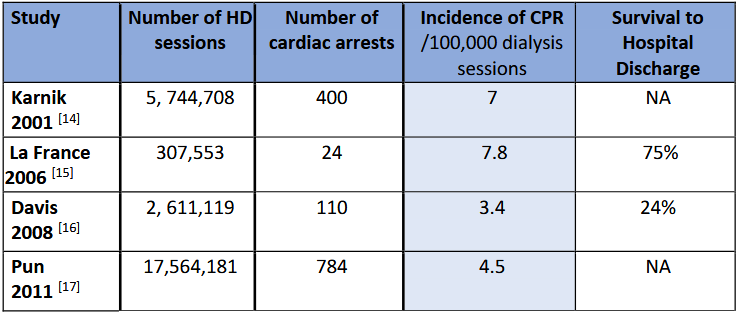
Table 35: Incidence and outcome of cardiac arrest in out patient dialysis units.
Within the out patient setting, most cardiac arrests occur during the dialysis session as shown in Table 36. Karnik et al reported that the mean time into dialysis at cardiac arrest was 123 ± 77 minutes.14 The mean time to cardiac arrest was shorter in patients with central venous catheters compared with arteriovenous fistulas. Electrolyte and fluid shifts may also play a role in the timing of events. The incidence of SCA is highest after the longest inter dialytic gap. Obremska et al (2021) reported that 42% of SCA occurred in dialysis patients on Mondays and Tuesdays compared with 29% in non dialysis patients.18 This trend was also noted in an earlier report.19
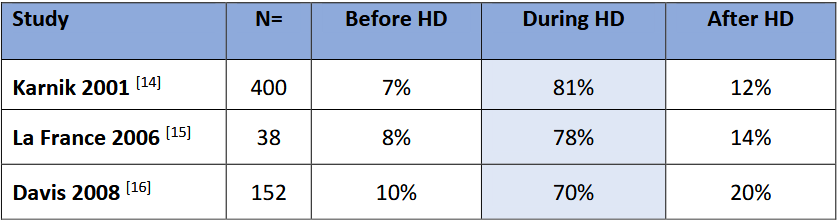
Table 36: Timing of cardiac arrest during dialysis in out patient centres.
Effect of rhythm on outcome
Shockable cardiac arrest rhythms (pulseless VT or VF) have been reported to be more common in the dialysis population than non shockable rhythms (PEA or asystole). Davis et al demonstrated a shockable primary arrest rhythm in 65% of arrests. Karnik et al reported the arrest rhythm in only 16% of cases but of these, the initial rhythm was VF/VT in 42%, VT in 20% and asystole in 15%.14 LaFrance et al reported data on the first cardiac arrest rhythm in only 12 patients VF/VT (6/12 patients), PEA/ asystole (6/12 patients).15
Shockable rhythms are associated with a higher incidence of return of spontaneous circulation (ROSC) and survival to hospital discharge in the general population as well as in patients with ESRD as shown in Table 37. Non shockable cardiac arrest rhythms are associated with a poor outcome. Registry data in the general population in the UK and USA demonstrate survival to hospital discharge of 11% in patients presenting with PEA/ asystole.3,20 In contrast, Wang et al reported a non shockable rhythm in 92.7% of IHCA in hyperkalaemic patients which in part accounts for the survival to hospital discharge of only 3.7% in this study.22
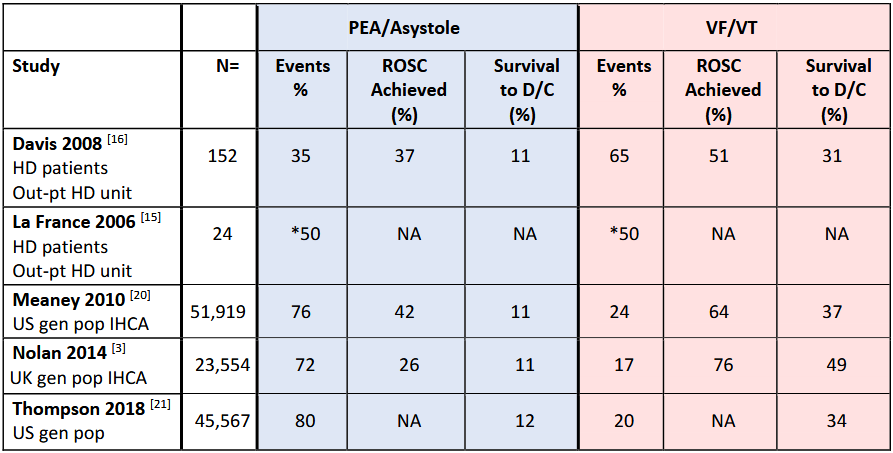
Table 37: Outcome of cardiac arrest in patients receiving haemodialysis (HD) in an outpatient dialysis facility versus all in hospital cardiac arrests.
PEA – pulseless electrical activity; VF – ventricular fibrillation; VT – ventricular tachycardia; ROSC – return of spontaneous circulation; IHCA – In hospital cardiac arrest NA – not available; D/C – discharge; Out pt – out patient; gen pop – general population * Data available for primary cardiac arrest rhythm in only 12/24 patients
Modifications to ALS in Renal Failure
The universal ALS algorithm applies to all patients and the initial steps of recognition of cardiac arrest, initiating high quality CPR with minimal interruption, and attempting defibrillation if required, are independent of the cause of cardiac arrest.
During CPR, reversible causes should be considered and treated. If the serum potassium is ≥ 6.5 mmol/L before or early in the resuscitation attempt, hyperkalaemia should be considered to be the potential cause of the cardiac arrest. Hyperkalaemia occurring late in the resuscitation attempt may be the consequence of progressive acidosis and hypoxia, and may not be the precipitant of the cardiac arrest or require specific intervention.
Special considerations during resuscitation in dialysis patients is shown in Table 38. The cardiac arrest team may have little knowledge of these considerations in dialysis patients, therefore expert help is essential for optimising care and safety.
The practice of defibrillation in HD units is variable across the UK and many staff are unaware of the safety considerations.23 The ERC Guidelines (2021) recommends disconnection from dialysis equipment prior to defibrillation, unless defibrillator proof, in keeping with the International Electrotechnical Committee (IEC) standards 60601 2 4.24 Most haemodialysis equipment is not defibrillator proof.
Special considerations during resuscitation of haemodialysis patients
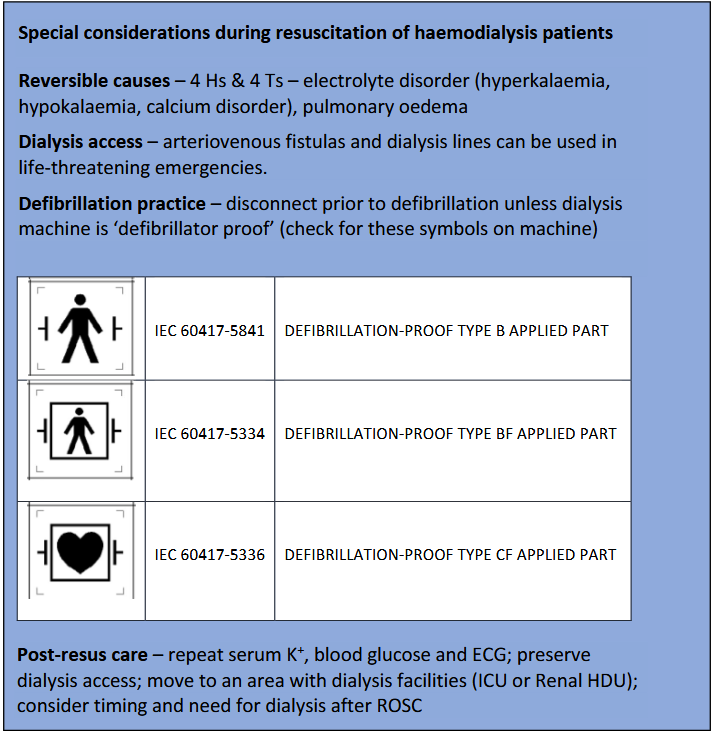
Table 38: Special considerations during resuscitation in haemodialysis patients.
Automated external defibrillators (AED) are now widely available for non expert use worldwide to facilitate early defibrillation. Many dialysis centres are predominantly nurse led. For this reason, the National Kidney Foundation KDOQI Guidelines (2005) mandated that all dialysis facilities should have on site capability of defibrillation and the use of AEDs is the simplest and most cost effective device.25 Lehrich et al investigated the use of AEDs in dialysis centres and reported that the presence of AEDs alone did not independently improve survival and suggested that further measures are required to affect outcome.
The impact of dialysis unit staff initiating resuscitation before arrival of paramedics has recently been reported to assess outcomes of staff led CPR and AED use. In this study of OHCA in out patient dialysis clinics (n=398 events), dialysis staff initiated CPR in 81% of events, but applied an AED before paramedics arrived in only 52.3%.26 The timing of events in relation to dialysis is not available. When dialysis staff were the first to apply the AED, there was a greater proportion of shockable rhythms (41% vs 25%), reinforcing early application of AED. The odds of survival to hospital discharge was 3 fold higher with staff initiated CPR, but there was only a non significant trend towards improved survival to discharge with staff initiated AED. This may be explained by the low usage of AED by nursing staff.
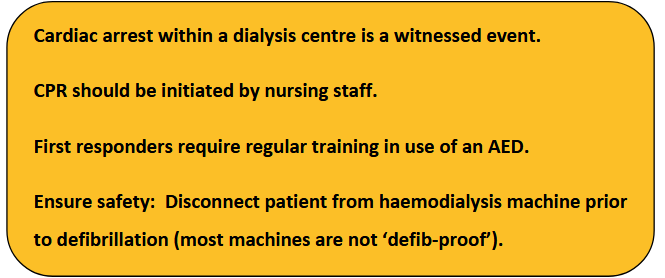
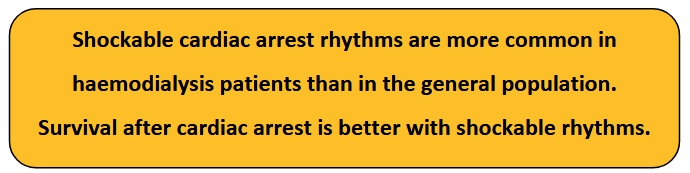
Within out patient dialysis centres, cardiac arrest occurs most often during dialysis thereby are witnessed events. Shockable rhythms are more common, therefore early defibrillation using safe practice should be attempted. Patients with a shockable rhythm have the best chance of survival, therefore prompt and effective action by first responders is crucial.
References
- Turakhia, M.P., et al., Chronic kidney disease and arrhythmias: conclusions from a Kidney Disease: Improving Global Outcomes (KDIGO) Controversies Conference. Eur Heart J, 2018. 39(24): p. 2314 2325.
- Saran, R., et al., US Renal Data System 2018 Annual Data Report: Epidemiology of Kidney Disease in the United States. Am J Kidney Dis, 2019. 73(3 Suppl 1): p. A7 A8.
- Nolan, J.P., et al., Incidence and outcome of in hospital cardiac arrest in the United Kingdom National Cardiac Arrest Audit. Resuscitation, 2014. 85(8): p. 987 92.
- NCAA. National Cardiac Arrest Audit key statistics. [Internet]. https://www.icnarc.org/DataServices/Attachments/Download/510fe606 a30b ea11 911e 00505601089b.
- Holmberg, M.J., et al., Annual Incidence of Adult and Pediatric In Hospital Cardiac Arrest in the United States. Circ Cardiovasc Qual Outcomes, 2019. 12(7): p. e005580.
- Andersson, A., et al., In hospital versus out of hospital cardiac arrest: Characteristics and outcomes in patients admitted to intensive care after return of spontaneous circulation. Resuscitation, 2022. 176: p. 1 8.
- Moss, A.H., J.L. Holley, and M.B. Upton, Outcomes of cardiopulmonary resuscitation in dialysis patients. J Am Soc Nephrol, 1992. 3(6): p. 1238 43.
- Wong, S.P., et al., Trends in in hospital cardiopulmonary resuscitation and survival in adults receiving maintenance dialysis. JAMA Intern Med, 2015. 175(6): p. 1028 35.
- Saeed, F., et al., Outcomes of In Hospital Cardiopulmonary Resuscitation in Maintenance Dialysis Patients. J Am Soc Nephrol, 2015. 26(12): p. 3093 101.
- Starks, M.A., et al., In Hospital Cardiac Arrest Resuscitation Practices and Outcomes in Maintenance Dialysis Patients. Clin J Am Soc Nephrol, 2020. 15(2): p. 219 227.
- Allencherril, J., et al., Etiologies of in hospital cardiac arrest: A systematic review and meta analysis. Resuscitation, 2022. 175: p. 88 95.
- Penketh, J. and J.P. Nolan, In hospital cardiac arrest: the state of the art. Crit Care, 2022. 26(1): p. 376.
- Genovesei, S., et al., Sudden cardiac death in dialysis patients: different causes and management strategies. Nephrol Dial Transplant, 2021. 36(3): p. 396 405.
- Karnik, J.A., et al., Cardiac arrest and sudden death in dialysis units. Kidney Int, 2001. 60(1): p. 350 7.
- Lafrance, J.P., et al., Predictors and outcome of cardiopulmonary resuscitation (CPR) calls in a large haemodialysis unit over a seven year period. Nephrol Dial Transplant, 2006. 21(4): p. 1006 12.
- Davis, T.R., et al., Outcome of cardiac arrests attended by emergency medical services staff at community outpatient dialysis centers. Kidney Int, 2008. 73(8): p. 933 9.
- Pun, P.H., et al., Modifiable risk factors associated with sudden cardiac arrest within hemodialysis clinics. Kidney Int, 2011. 79(2): p. 218 27.
- Obremska, M., et al., Out of hospital cardiac arrest in dialysis patients. Int Urol Nephrol, 2021.
- Bleyer, A.J., et al., Characteristics of sudden death in hemodialysis patients. Kidney Int, 2006. 69(12): p. 2268 73.
- Meaney, P.A., et al., Rhythms and outcomes of adult in hospital cardiac arrest. Crit Care Med, 2010. 38(1): p. 101 8.
- Thompson, L.E., et al., Long Term Survival Trends of Medicare Patients After In Hospital Cardiac Arrest: Insights from Get With The Guidelines Resuscitation((R)). Resuscitation, 2018. 123: p. 58 64.
- Wang, C.H., et al., The effects of calcium and sodium bicarbonate on severe hyperkalaemia during cardiopulmonary resuscitation: A retrospective cohort study of adult in hospital cardiac arrest. Resuscitation, 2016. 98: p. 105 11.
- Bird, S., et al., Defibrillation during renal dialysis: a survey of UK practice and procedural recommendations. Resuscitation, 2007. 73(3): p. 347 53.
- Lott, C., et al., European Resuscitation Council Guidelines 2021: Cardiac arrest in special circumstances. Resuscitation, 2021. 161: p. 152 219.
- National Kidney Foundation: Kidney Disease Outcomes Quality Initiative. Clinical Practice Guidelines for Cardiovascular Disease in Dialysis Patients. NKF KDOQI: Section I, Guideline 8, 2005.
- Pun, P.H., et al., Outcomes for Hemodialysis Patients Given Cardiopulmonary Resuscitation for Cardiac Arrest at Outpatient Dialysis Clinics. J Am Soc Nephrol, 2019.