
II. Hyperkalaemia in Hospitalised Patient (Guidelines Hyperkalaemia 20.1 – 20.2)
Guideline 20.1 Hyperkalaemia: Transfer to renal services
We suggest that transfer to renal services be considered in clinically stable patients in whom hyperkalaemia cannot be controlled (i.e. serum K+ < 6.5 mmol/L) using medical measures, particularly in the presence of advanced or oliguric renal failure (either AKI or CKD). (2C)
Guideline 20.2 Hyperkalaemia: Minimum standards for safe patient transfer
We suggest that any inter or intra hospital patient transfer is coordinated by senior clinicians and follows national guidelines. (2B)
Rationale (Guidelines 20.1 – 20.2)
The most important aspect of patient transfer is ensuring safety. There are three key steps in optimising patient transfer – firstly, to decide if transfer is absolutely necessary; secondly, to optimise the patient prior to transfer; and thirdly, to coordinate and perform the transfer itself.
The decision to transfer the patient with hyperkalaemia will be guided by the availability of renal services locally. Intra hospital patient transfer from a ward or emergency department to a high dependency area, renal unit or ICU within a hospital is less complicated, but still requires good communication and coordination. Cardiac monitoring and resuscitation equipment are essential for the transfer of patients with hyperkalaemia, either within or between hospitals.
Inter hospital transfer to the nearest renal unit or ICU may be required for definitive management. This decision must be made by the responsible consultant, in conjunction with consultant colleagues from relevant specialties in both the referring and receiving hospitals. The timing and urgency of transfer will be decided by the nephrologist and/or intensivist. Critical care review is essential for patients with any concern regarding oxygenation, ventilation or haemodynamic instability. The decision to accept a transferred patient should be made by a consultant in the receiving unit.
Pre transfer stabilisation is important,1,3 but should not cause undue delay if transfer is required to facilitate urgent dialysis. Inter hospital transfer of a patient with severe hyperkalaemia carries increased risk, therefore this decision should be taken by a consultant who will carefully weigh this risk guided by the location of intensive care and dialysis facilities.
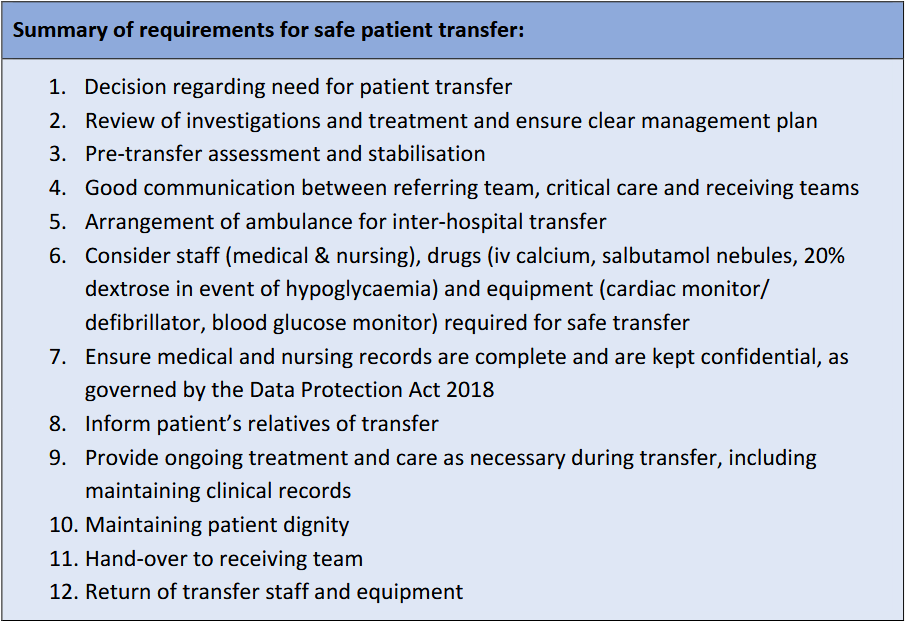
Table 31: Minimum standards for safe patient transfer.
Adapted from Dunn (2007)[3], FICM guidelines (2019)[1], ICS guidelines (2011)[4], NICE(2017) [5]
The organisation of the patient transfer itself requires a coordinated approach and liaison with the receiving team. The use of a transfer checklist, protocols and skilled staff reduce mortality. The clinical risk of the transfer and the level of competence required by escorting staff will be guided by the patient’s condition.
Every hospital should have suitable arrangements in place for providing patient transfer including trained personnel, equipment, and drugs to treat the specific problem. Hospitals should form transfer networks to co ordinate and manage clinically indicated transfers.2 Record keeping is a legal requirement for all patient transfers.1 Clear records should be maintained at all stages of transfer including the patient’s condition, reason for transfer, names of referring and accepting consultants, clinical status prior to transfer, during transfer and on arrival. Arrangements should be in place for the return of staff and equipment after transfer. The procedure for safe patient transfer is summarised in Table 31.
Prompt clinical re assessment by the receiving medical team is required following transfer, including observations, bloods and ECG. The K+ lowering effect of medical treatment for hyperkalaemia is temporary (< 6 hours), therefore repeat bloods to assess for rebound hyperkalaemia is important (Guideline 17.1). The potential for hypoglycaemia after administration of insulin glucose should be considered and blood glucose checked on arrival. Kitchlu et al found that inter hospital transfer to facilitate RRT did not confer higher mortality or worse renal outcomes.6
References
- Faculty of Intensive Care Medicine. Guidance On: The Transfer of the Critically Ill Adult. 2019. www.ficm.ac.uk/sites/default/files/transfer_critically_ill_adult_2019.
- Bourn, S., S. Wijesingha, and G. Nordmann, Transfer of the critically ill adult patient. Bja Education, 2018. 18(3): p. 63 68.
- Dunn, M.J., C.L. Gwinnutt, and A.J. Gray, Critical care in the emergency department: patient transfer. Emerg Med J, 2007. 24(1): p. 40 4.
- Whiteley, S. Guidelines for the transport of the critically ill adult (3rd Edition 2011). Intensive Care Society 2011.
- National Institute for Health and Care Excellence. Standardised systems of care for intra and inter hospital transfers. [NG94]. March 2018.
- Kitchlu, A., et al., Interhospital Transfer and Outcomes in Patients with AKI: A Population Based Cohort Study. Kidney360, 2020. 1(11): p. 1195 1205.