
Hyperkalaemia in the Community (Guideline 9.1)
Guideline 9.1 – Patiromer for the management of Hyperkalaemia in the community
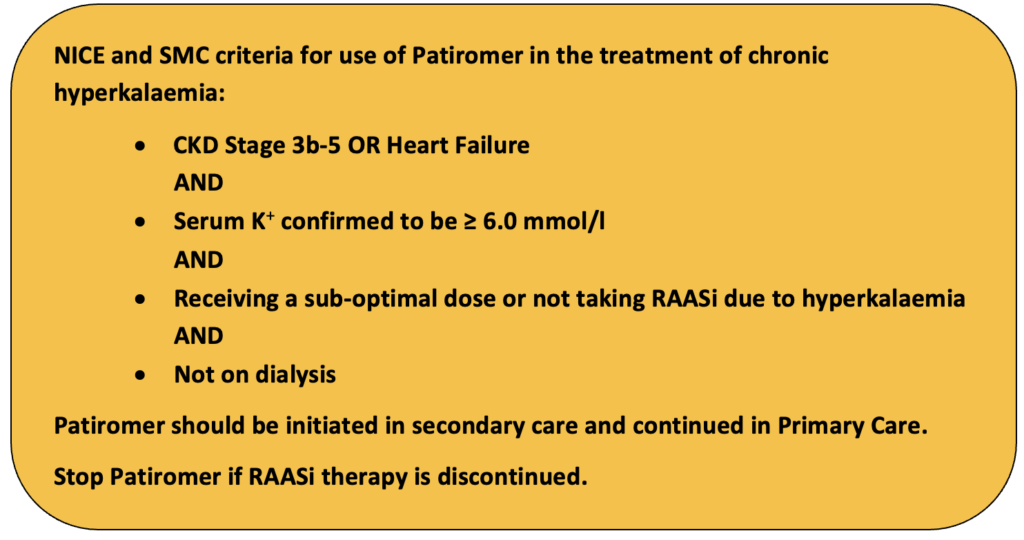
We recommend that Patiromer is an option in the management of persistent hyperkalaemia with a confirmed serum K+ ≥ 6.0 mmol/l in out patients with CKD Stage 3b–5 (not on dialysis) or heart failure receiving a sub optimal dose or not receiving RAASi therapy due to hyperkalaemia. (1A)
Guideline 9.2 – Patiromer for the management of Hyperkalaemia
We recommend that treatment with Patiromer is discontinued if RAASi therapy is stopped. (1A)
Guideline 9.3 – Patiromer for the management of Hyperkalaemia
We recommend that Patiromer is initiated in secondary care only. (1A)
Audit measures
The proportion of adults with moderate hyperkalaemia (serum K+ 6.0 6.4 mmol/l) treated with patiromer who achieved a serum K+ ≤ 5.0 mmol/l within 1 week in the out patient setting.
- The proportion of adults who achieve maximal dose RAASi therapy whilst taking patiromer in the out patient setting.
Rationale (Guideline 9.1 – 9.3)
Patiromer is a non absorbed, sodium free, K+ binding polymer.1 Calcium is used, rather than sodium, as the counter ion for K+ exchange. This avoids the potential for excessive sodium absorption and volume overload. The drug is active throughout the gastrointestinal tract but mostly in the colon. The onset of action is slow at 4–7 hours.1 Patiromer has the potential to bind to some co administered oral medication (e.g., metformin, levothyroxine and ciprofloxacin), therefore administration needs to be separated from other oral medications by ≥3 hours.1
Until the availability of K+ binders, the standard approach to treating chronic hyperkalaemia has been a dose reduction or cessation of cardioprotective medication along with the institution of a modified K+ intake. Dietary K+ restriction was implemented in patiromer trials and K+ lowering drugs are unlikely to replace dietary modifications although may allow a less restrictive intake.
The definition of hyperkalaemia used in the patiromer trials to guide treatment differed from the Renal Association (2014)2 and European Resuscitation Council (2015)3 guidelines available at that time. In the patiromer trials, mild hyperkalaemia was defined as serum K+ 5.1 5.4 mmol/l and moderate to severe hyperkalaemia as serum K+ 5.5 6.4 mmol/l.4 9 Early studies included 3 Phase I clinical pharmacology studies and 12 single dose drug drug interaction studies as summarised in Table 7.10
Evidence base for Patiromer for chronic hyperkalaemia
In the PEARL HF11 and PEARL HF extension9 studies, all participants had a diagnosis of chronic heart failure. Fewer patients in OPAL HK (42%)5 and AMETHYST DN (35%)6 had heart failure. In the PEARL HF study, almost half of the patients treated with patiromer developed hypokalaemia (K+ < 4 mmol/l) which also infers a higher risk of mortality in heart failure. However, in the PEARL HF extension study, spironolactone could be optimised with a lower starting dose of patiromer whilst reducing the incidence of hypokalemia.
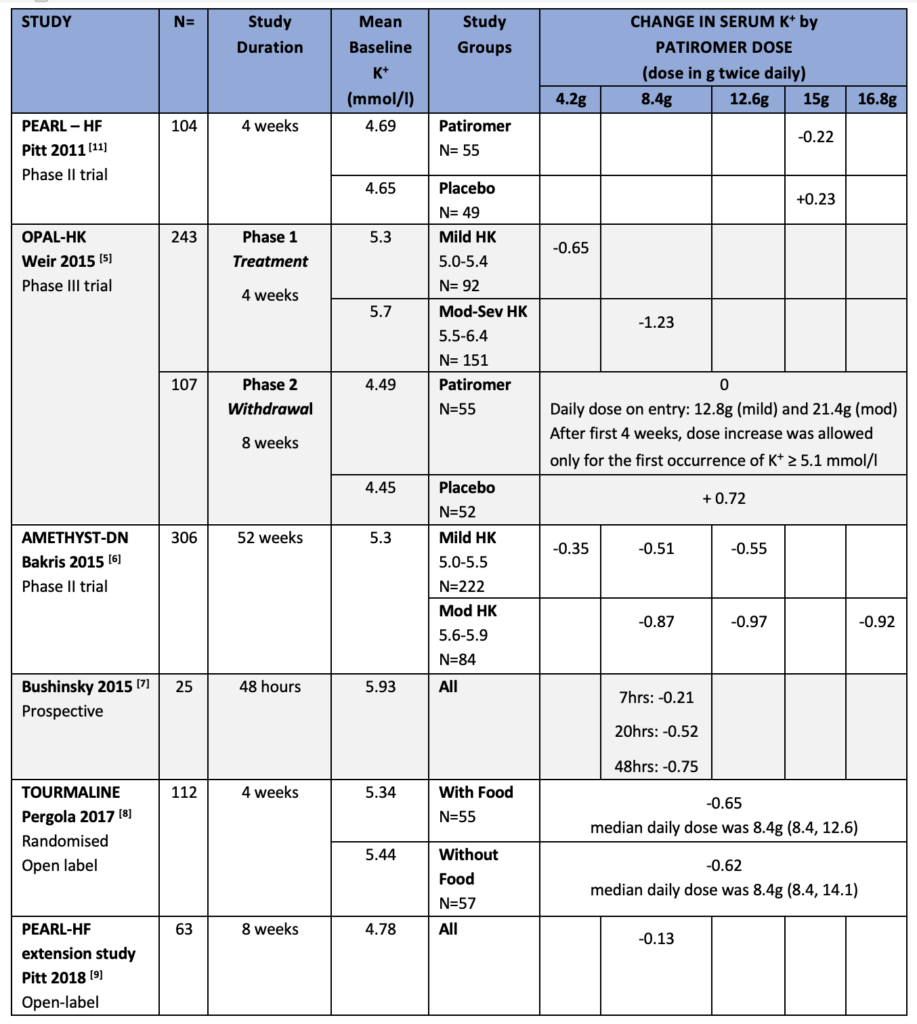
In the OPAL HK trial, 76% of patients with HF (NYHA Class I–III) achieved serum K+ levels within the target range with patiromer treatment. Hypokalaemia (K+ <3.5 mmol/l) occurred in 3% of patients. During the withdrawal phase, hyperkalaemia (K+ ≥5.5 mmol/l) recurred in 52% of patients compared with 8% in patients who remained on patiromer. By the end of the 8 week period, 100% in the patiromer group remained on RAASi compared with only 55% in the placebo group.
Patients with CKD were well represented in the clinical trials – Bushinsky (100%), OPAL HK (100%), PEARL HF extension study (100%), AMETHYST DN (87%) and Tourmaline (76%). Notably, the original PEARL HF, involving MRA titration, included few patients with CKD (27%) and the study duration may have been too short (4 weeks) to detect a worsening of renal function. In contrast, worsening of renal function was found in 9.2% of participants of the AMETHYST DN trial (52 weeks)6 and 13% of participants in the PEARL HF extension study (8 weeks)9. In both of these studies, spironolactone was implicated in some cases. In AMETHYST DN, this was the most frequently reported adverse event and was the most common cause for discontinuation. Despite its duration, this study also failed to show any clinically significant reduction in albuminuria.
A meta analysis of the major clinical trials (2015) showed that the mean reduction in serum K+ at Day 3 was 0.36 mmol/l and at 4 weeks was 0.70 mmol/l.11,12 Overall, 93% of patients could continue, start or titrate RAASi therapy during the maintenance phase of the studies.12
The AMBER trial was a Phase 2 RCT to investigate the efficacy of Patiromer vs placebo in patients with resistant hypertension and CKD (eGFR 25–45 ml/min).13 At 12 weeks, 86% of patients treated with Patiromer compared with 66% treated with placebo remained on spironolactone (p<0.0001).
Haller et al (2022) performed a pooled analysis of three RCTs (AMETHYST DN, OPAL HK, and TUROMALINE) to determine the safety and efficacy of Patiromer in hyperkalaemic patients with CKD most of whom were receiving a RAASi.14 Patients were stratified into two groups based on renal function: mild/moderate (eGFR ≥ 45ml/min) and severe/end stage (eGFR < 45 ml/min) and data over a 4 week treatment period was assessed. The mean reduction in serum K+ was 0.6 mmol/l and 0.84 mmol/l respectively. Patiromer discontinuation due to adverse effects was 2% and 6% respectively.
Zhuo et al (2022) assessed the risk of hospitalisation for heart failure in patients with hyperkalaemia treated with Sodium Zirconium Cyclosilicate (SZC) vs Patiromer.15 Although the incidence of hospitalisation was higher in the SZC vs Patiromer group (35.8/1000 vs 25.1/1000 person years), it did not reach statistical significance.
The DIAMOND trial (2022) investigated the use of Patiromer for managing hyperkalaemia in patients with heart failure with reduced ejection fraction.16 Patients with current or historic RAASi related hyperkalaemia (n=1642) were enrolled in a placebo controlled run in phase of up to 12 weeks. Patiromer was used whilst concurrently optimising RAASi and MRA therapy to specified target doses which was achieved in 84.6% of patients. The risk of hyperkalaemia (K+ > 5.5 mmol/l) and reduction of MRA dose was lower in the Patiromer group.
Recommendation for use of Patiromer for chronic hyperkalaemia
Patiromer was approved for the treatment of chronic hyperkalaemia in the USA in 2015 and in the EU in 2017. The major caveat is that twice daily patiromer dosing was utilized in most trials, whereas the FDA approved dose is once daily. This modification stems from concern over the potential for drug interaction between patiromer and other co administered medications as discussed above.
NICE17 and SMC18 have approved the use of patiromer in the treatment of chronic hyperkalaemia. The key evidence for clinical effectiveness was derived from the OPAL HK study which showed a reduction in serum K+ by a mean of 1.01 mmol/l after 4 weeks (Phase 1).5
The Cochrane review of potassium binders for chronic hyperkalaemia in people with CKD (2020) included 15 studies (n=1849 participants).19 Three of these studies were among patients treated with haemodialysis. Binders included calcium polystyrene sulfonate, sodium polystyrene sulfonate, patiromer, and sodium zirconium cyclosilicate. The certainty of evidence for all outcomes was low and studies were not designed to measure clinical outcomes such as arrhythmias. Patiromer made little to no difference to death.
Blood monitoring for patients treated with Patiromer for chronic hyperkalaemia
The drug data sheet suggests that serum K+ should be monitored as clinically indicated.1 A reasonable approach would be weekly for the first month after every dose titration, and then monthly thereafter.
A rebound in serum K+ occurs on cessation of patiromer, therefore withdrawal should be undertaken cautiously. The serum K+ may rise as early as two days after cessation of patiromer, especially if RAASi therapy is continued,1 therefore monitor serum K+ within one week after drug cessation.
References
- Vifor Fresenius Medical Care Renal Pharma UK. Veltassa (Patiromer): Annex 1 Summary of Product Characteristics. www.ema.europa.eu/en/documents/product information/veltassa
- Alfonzo, A., et al. Clinical Practice Guidelines: Treatment of acute hyperkalaemia in adults. UK Renal Association. March 2014. www.renal.org/wp content/uploads/2017/06/hyperkalaemia guideline 1
- Truhlar, A., et al., European Resuscitation Council Guidelines for Resuscitation 2015: Section 4. Cardiac arrest in special circumstances. Resuscitation, 2015. 95: p. 148 201.
- Pitt, B., et al., The PEARL HF (Multicenter, Randomized, Double blind, Placebo Controlled, Parallel Group, Multiple Dose to Evaluate the Effects of RLY5016 in Heart Failure Patients) Trial. Journal of Cardiac Failure, 2010. 16(11): p. 912.
- Weir, M.R., et al., Patiromer in patients with kidney disease and hyperkalemia receiving RAAS inhibitors. N Engl J Med, 2015. 372(3): p. 211 21.
- Bakris, G.L., et al., Effect of Patiromer on Serum Potassium Level in Patients With Hyperkalemia and Diabetic Kidney Disease: The AMETHYST DN Randomized Clinical Trial. JAMA, 2015. 314(2): p. 151–61.
- Bushinsky, D.A., et al., Patiromer induces rapid and sustained potassium lowering in patients with chronic kidney disease and hyperkalemia. Kidney Int, 2015. 88(6): p. 1427–1433.
- Pergola, P.E., et al., Patiromer Lowers Serum Potassium When Taken without Food: Comparison to Dosing with Food from an Open Label, Randomized, Parallel Group Hyperkalemia Study. Am J Nephrol, 2017. 46(4): p. 323–332.
- Pitt, B., et al., Evaluation of an individualized dose titration regimen of patiromer to prevent hyperkalaemia in patients with heart failure and chronic kidney disease. ESC Heart Fail, 2018. 5(3): p. 257–266.
- Veltassa (Patiromer): European Medicines Agency Assessment report. 2017. Procedure No. EMEA/H/C/004180/0000. www.ema.europa.eu/en/documents/assessment report/veltassa epar public assessment report_en.
- Pitt, B., et al., Evaluation of the efficacy and safety of RLY5016, a polymeric potassium binder, in a double blind, placebo controlled study in patients with chronic heart failure (the PEARL HF) trial. Eur Heart J, 2011. 32(7): p. 820–8.
- Meaney, C.J., et al., Systematic Review and Meta Analysis of Patiromer and Sodium Zirconium Cyclosilicate: A New Armamentarium for the Treatment of Hyperkalemia. Pharmacotherapy, 2017. 37(4): p. 401–411.
- Agarwal, R., et al., Patiromer versus placebo to enable spironolactone use in patients with resistant hypertension and chronic kidney disease (AMBER): a phase 2, randomised, double blind, placebo controlled trial. Lancet, 2019. 394(10208): p. 1540–1550.
- Haller, H., et al., Safety and Efficacy of Patiromer in Hyperkalemic Patients with CKD: A Pooled Analysis of Three Randomized Trials. Kidney360, 2022. 3(12): p. 2019–2026.
- Zhuo, M., et al., Risk of Hospitalization for Heart Failure in Patients With Hyperkalemia Treated With Sodium Zirconium Cyclosilicate Versus Patiromer. J Card Fail, 2022. 28(9): p. 1414–1423.
- Butler, J., et al., Patiromer for the management of hyperkalemia in heart failure with reduced ejection fraction: the DIAMOND trial. Eur Heart J, 2022. 43(41): p. 4362–4373.
- National Institute for Health and Care Excellence – Patiromer for treating hyperkalaemia. Technology appraisal guidance [TA623]. February 2020. www.nice.org.uk/guidance/TA623.
- Scottish Medicines Consortium (SMC): Patiromer sorbitex calcium (Veltassa®) is accepted for restricted use within NHSScotland. SMC2381. July 2021. https://www.scottishmedicines.org.uk/medicines advice/patiromer sorbitex calcium veltassa abb smc2381/.
- Natale, P., et al., Potassium binders for chronic hyperkalaemia in people with chronic kidney disease. Cochrane Database Syst Rev, 2020. 6(6): p. CD013165.