
Guideline 2.1 – Assessment of patients prior to initiation of ACE I or ARB
We recommend that urea and electrolytes should be assessed prior to initiation of ACE I or ARB and these drugs should be used with caution if the serum K⁺ is > 5.0 mmol. (1A)
Guideline 2.2 – Assessment of patients prior to initiation of Mineralocorticoid Receptor Antagonists (MRA)
We suggest that initiation of MRAs should be avoided in patients with a baseline serum K⁺ > 5.0mmol/l or eGFR < 30 ml/min. (1B)
Guideline 2.3 – Monitoring of patients after initiation of ACE I and ARB
We recommend that urea and electrolytes should be assessed at 1 – 2 weeks after initiation of ACE I or ARB and after every dose titration. (1A)
Guideline 2.4 – Monitoring of patients after initiation of MRAs
We recommend that urea and electrolytes should be assessed at 1 week after initiation of MRA or after dose up titration, then monthly for the first 3 months, 3 monthly for the first year and 4 monthly thereafter. (1A)
Guideline 2.5 – Management of hyperkalaemia in patients treated with RAASi drugs
We suggest increased frequency of monitoring in patients with a serum K⁺ between 5.5–5.9 mmol/l and consideration of dose reduction of RAASi drugs (ACE I, ARB, MRA). (1B)
Guideline 2.6 – Management of hyperkalaemia in patients treated with RAASi drugs during acute illness
We recommend that RAASi drugs be withheld during acute intercurrent illness (e.g. sepsis, hypovolaemia and/or AKI) at all severities of hyperkalaemia. (1D)
Guideline 2.7 – Cessation of RAASi drugs in patients with moderate or severe hyperkalaemia
We recommend cessation of RAASi drugs in patients with serum K⁺ ≥ 6 mmol/l who do not meet the criteria for treatment with patiromer or sodium zirconium cyclosilicate. (1B)
Audit measure
- Frequency of blood monitoring for patients receiving RAASi drugs in the community.
Rationale (Guidelines Hyperkalaemia 2.1 – 2.7)
Patients with CKD, heart failure and diabetes are particularly at risk of hyperkalaemia and these conditions often co exist. RAASi drugs have become the standard of care to slow progression of CKD and in the management of patients with diabetes and heart failure, but has resulted in an increased frequency of hyperkalaemia.
Impact of hyperkalaemia on optimisation of RAASi/MRA therapy
Hyperkalaemia frequently limits use or titration of RAASi drugs. Epstein et al conducted a large study (> 7 million patient records) to determine the impact of hyperkalaemia on the optimal vs real-world treatment with RAASi.1 In patients for whom RAASi was recommended by treatment guidelines for cardiorenal disease, >50% were prescribed lower than recommended dose and 14–16% discontinued RAASi therapy.1
Suboptimal treatment for patients with heart failure and renal disease also affects patient outcomes. Mortality rates has been shown to be higher in patients who receive submaximal dosing (8%) and in those who have discontinued RAASi (11%) compared to those who received maximal dosing (4%).2 Similarly, Ouwerkerk et al demonstrated increased hospitalisation and increased mortality in patients with heart failure with reduced ejection fraction (HFrEF) who receive less than half of the recommended doses of ACE I or ARB (HR 1.72) and beta blockers (HR 1.70) compared with patients who reached optimal doses.3
Discontinuation of RAASi therapy in patients with CKD after an episode of hyperkalaemia has been shown to be associated with an increased risk of cardiovascular events and death.4–6 The balance between optimising treatment and compromising renal function poses a significant clinical dilemma. Strategies to maintain RAASi treatment after an episode of hyperkalaemia may improve clinical outcomes in the CKD population and discontinuation should be avoided where possible.7
Blood monitoring during RAASi therapy
The aim of blood monitoring of serum K⁺ in patients receiving RAASi drugs is to reduce the risk of adverse events. Raebel et al demonstrated that patients with diabetes who underwent K⁺ monitoring during the first year of treatment with RAASi drugs were less likely to experience hyperkalaemia associated adverse events (hospitalisation, Emergency Department attendance or death) with an adjusted relative risk of 0.50 (0.37, 0.66) compared to those who were not monitored.8
Park et al conducted an observational study of hospitalised patients newly started on an ARB and demonstrated that the highest incidence of hyperkalaemia occurred on the first day and 52.4% of hyperkalaemic events occurred within the first week of initiation.9
Jun et al assessed the timing of onset of hyperkalaemia in hospitalised patients following recent initiation of an ACE I or ARB and found that 50.9% of patients developed hyperkalaemia at a K⁺ level up to 5.5 mmol/l and 47.6% of patients developed hyperkalaemia at a K⁺ level up to 6 mmol/l within the first week.10
National recommendations are shown below. Adherence to guideline recommendations appears to be poor. In a large population-based study of new users of RAASi drugs, < 33% of patients had a K⁺ measurement within 30 days of drug initiation and only 76% had at least one measurement within the first year of treatment.14 In another study, Chang et al reported that 20% of patients had no serum K⁺ monitoring within 3 years of initiation of antihypertensive medication that affect potassium levels.15
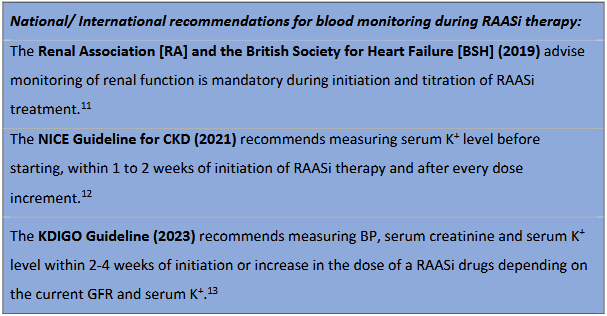
Two large population-based cohort studies performed to assess whether follow-up testing reduces treatment-related adverse events showed that follow-up blood testing was associated with increased 30-day hospitalisation or ED attendances with AKI and hyperkalaemia, but did not lower 30-day all-cause mortality.16
When to reduce or stop RAASi drugs
RAASi drugs can cause a rise in serum K⁺, creatinine or both after initiation or after a dose up titration. Within acceptable parameters, no change in treatment is necessary, but outwith these parameters (see below), a dose reduction or drug cessation may be required.
- The NICE CKD Guideline (2021) recommends that RAASi drugs should be withdrawn if the serum K⁺ is ≥ 6 mmol/l. If serum creatinine increases by > 30% above baseline (equivalent to fall in eGFR > 25%), reduce or stop RAASi unless alternative cause is found.12
- The KDIGO Guideline (2023) recommends continuation of RAASi unless serum creatinine rises by > 30% within 4 weeks following initiation of treatment or an increase in dose.13
- During acute illness (see ‘Sick Day Rules’ below).11, 17
When to consider K+ binders for chronic hyperkalaemia
NICE has approved the use of K+ binders (patiromer and sodium zirconium cyclosilicate) in selected patients with CKD 3b-5 (not on dialysis) or heart failure who have confirmed persistent hyperkalaemia with a serum K+ ≥ 5.5 mmol/l and are not receiving an optimal dose of RAASi.17, 18 According to this guidance, RAASi should be withdrawn in patients with a serum K+ ≥ 6 mmol/l who do not meet the criteria for these novel K+ binders.
In contrast, the European Society of Cardiology (ESC) Guidelines for the diagnosis and treatment of acute and chronic heart failure suggest an approved K⁺ binder may be initiated ‘as soon as K⁺ levels are ≥ 5.0 mmol/l’ in patients with chronic or recurrent hyperkalaemia to facilitate optimisation of RAASi therapy.20
The KDIGO Guideline (2023) suggests considering dose adjustment (or cessation) of K⁺ elevating drug or starting a licensed K⁺ binder to manage hyperkalaemia (K⁺ > 5.5 mmol/l) in patients with CKD once other correctable factors and dietary K⁺ intake have been considered.13
In the context of blood pressure management, the European Society of Hypertension Guidelines (2023) have recommended that a serum K⁺ ≥ 5.5 mmol/l is a ‘compelling contraindication’ for both RAASi and MRA therapy.21 This guideline does not specifically state initiation at this threshold, but suggests that K⁺ binders can be used in CKD patients with hyperkalaemia to maintain normal or near normal serum K⁺ levels (< 5.5 mmol/l), thereby allowing continuation and optimisation of RAASi or MRA therapy.
Inconsistent guidelines on the timing for initiation of K⁺ binders is likely to lead to variable clinical practice, especially in patients with moderate hyperkalaemia (K⁺ 5.5–5.9 mmol/l).
When to temporarily withhold RAASi drugs
The ‘sick day rules’ for patients with diabetes, kidney or cardiovascular disease provides guidance to temporarily stop some medications (RAASi, diuretics, metformin, SGLT2i) during acute dehydrating illness (e.g. diarrhoea and vomiting).17
The RA/BSH (2019) advise withdrawal of RAASi at all severities of hyperkalaemia in the context of acute illness (sepsis, hypovolaemia and/or AKI).11 However, in the context of decompensated heart failure, the continuation/reduction of RAASi therapy was permitted in patients with mild or moderate hyperkalaemia, but withdrawn if serum K⁺ ≥ 6.5 mmol/l.
The KDIGO Guideline (2023) recommends reducing or discontinuing RAASi in the setting of either symptomatic hypotension or uncontrolled hyperkalaemia despite medical treatment or to reduce uraemic symptoms while treating kidney failure (eGFR < 15 ml/min).13
When to restart RAASi drug after acute illness
An important consideration in the management of an episode of hyperkalaemia is the balance between the immediate risk vs the impact of cessation of RAASi drugs in patients for whom these drugs are crucial in controlling symptoms and improving survival. Minimising the duration of cessation of treatment and clear communication after hospital discharge is essential.
The RA/BSH (2019) advise RAASi re introduction after recovery and when K⁺ is < 5.5 mmol/l.11 Patients receiving multiple RAASi drugs and/or MRA should re start one drug at a time.11
Involvement of specialist services, renal and heart failure teams, may facilitate safer re introduction of treatment.
MRAs
Mineralocorticoid receptor antagonists (MRAs) have significantly improved heart failure management, but their use alone or in combination with RAASi, may exacerbate hyperkalaemia.
The European Society of Cardiology22 and American Heart Association (AHA)/American College of Cardiology (ACC)23 have provided guidance for the initiation, monitoring and titration of MRAs.
- Acceptable baseline parameters: serum K⁺ < 5.0 mmol/l and an eGFR > 30ml/min.
- Monitor Urea & Electrolytes (U&Es) at 1, 4, 8 and 12 weeks following initiation.
- Thereafter, monitor U&Es every 3 months during 1st year
- From 2nd year onwards, monitor U&Es every 3–4 months.
The approach to treating hyperkalaemia in patients with heart failure on MRA is shown in the text box below. In patients without heart failure, drug cessation is recommended if serum K⁺ ≥ 6.0 mmol/l.
Strategies for Managing Hyperkalaemia in patients with Heart failure on MRA
- K+ 5-5.9 mmol/l: Reduce dose by half and monitor U&Es
- K+ > 6.0 mmol/l: Start potassium binder (Patiromer or SZC) and monitor U&Es
Combined treatment of RAASi and an aldosterone antagonist increase the risk of hyperkalaemia, but Sinnott et al reported <33% of patients taking a RAASi had biochemical monitoring within two weeks of initiation of an aldosterone antagonist.24 This highlights the gap in knowledge and clinical practice.
Nonsteroidal MRAs
Finerenone is a novel nonsteroidal, selective MRA which has been shown to improve cardio renal outcomes in patients with CKD and Type 2 diabetes.25, 26 However, Finerenone was associated with a 2 fold higher risk of hyperkalaemia compared with placebo in the FIDELIO DKD Trial.25
The KDIGO CKD Guideline (2023) suggests a nonsteroidal MRA (e.g. Finerenone) may be used in patients with Type 2 diabetes with an eGFR > 25ml/min, normal serum K⁺ level, and albuminuria > 3 mg/mmol, despite maximum tolerated dose of RAASi.13 A nonsteroidal MRA may be added to a RAASi and an SGLT2i for treatment of Type 2 diabetes and CKD in adults. To mitigate the risk of hyperkalaemia, serum K⁺ should be monitored regularly. If serum K⁺ > 5.5 mmol/l, Finerenone should be withheld.
The European Society of Hypertension Guideline (2023) also recommends the use of Finerenone in patients with CKD and albuminuria associated with Type 2 diabetes mellitus if the eGFR is ≥ 25 ml/min and the serum K⁺ is <5.0 mmol/l.21
References
- Epstein, M., Hyperkalemia constitutes a constraint for implementing renin angiotensin aldosterone inhibition: the widening gap between mandated treatment guidelines and the real world clinical arena.Kidney Int Suppl (2011), 2016. 6(1): p. 20–28.
- Epstein, M., et al., Evaluation of the treatment gap between clinical guidelines and the utilization of renin angiotensin aldosterone system inhibitors.Am J Manag Care, 2015. 21(11 Suppl): p. S212–20.
- Ouwerkerk, W., et al., Determinants and clinical outcome of uptritation of ACE inhibitors and beta blockers in patients with heart failure: a prospective European study.Eur Heart J, 2017. 38(24): p. 1883–1890.
- Santoro, A., et al., Association between hyperkalemia, RAASi non adherence and outcomes in chronic kidney disease.J Nephrol, 2022. 35(2): p. 463–472.
- Fu, E.L., et al., Stopping Renin Angiotensin System Inhibitors in Patients with Advanced CKD and Risk of Adverse Outcomes: A Nationwide Study.J Am Soc Nephrol, 2021. 32(2): p. 424–435.
- Yang, A., et al., Clinical outcomes following discontinuation of renin angiotensin system inhibitors in patients with type 2 diabetes and advanced chronic kidney disease: A prospective cohort study.EClinicalMedicine, 2023. 55: p. 101751.
- Leon, S.J., et al., Hyperkalemia Related Discontinuation of Renin Angiotensin Aldosterone System Inhibitors and Clinical Outcomes in CKD: A Population Based Cohort Study.Am J Kidney Dis, 2022. 80(2): p. 164–173 e1.
- Raebel, M.A., et al., Diabetes and drug associated hyperkalemia: effect of potassium monitoring.J Gen Intern Med, 2010. 25(4): p. 326–33.
- Park, I.W., et al., Onset time of hyperkalemia after angiotensin receptor blocker initiation: when should we start serum potassium monitoring?J Clin Pharm Ther, 2014. 39(1): p. 61–8.
- Jun, H.R., et al., Onset of Hyperkalemia following the Administration of Angiotensin Converting Enzyme Inhibitor or Angiotensin II Receptor Blocker.Cardiovasc Ther, 2021. 2021: p. 9539149.
- Bandak, G., et al., Hyperkalemia After Initiating Renin-Angiotensin System Blockade: The Stockholm Creatinine Measurements (SCREAM) Project. J Am Heart Assoc, 2017. 6(7).
- Chang, A.R., et al., Antihypertensive Medications and the Prevalence of Hyperkalemia in a Large Health System. Hypertension, 2016. 67(6): p. 1181-8.
- Clark, A.L., et al., Change in renal function associated with drug treatment in heart failure: national guidance.Heart, 2019. 105(12): p. 904–910.
- National Institute for Health and Care Excellence (NICE): Chronic Kidney Disease – assessment and management.NICE guideline [NG203] Published: 25 August 2021.
- KDIGO 2023 Clinical Practice Guideline for the Evaluation and Management of Chronic Kidney Disease. (draft). July 2023.
- Parikh, R.V., et al., Kidney Function and Potassium Monitoring After Initiation of Renin-Angiotensin-Aldosterone System Blockade Therapy and Outcomes in 2 North American Populations. Circ Cardiovasc Qual Outcomes, 2020. 13(9): p. e006415.
- National Institute for Health and Care Excellence – Patiromer for treating hyperkalaemia. Technology appraisal guidance [TA623]. February 2020. www.nice.org.uk/guidance/TA623.
- National Institute of Clinical Excellence. Sodium Zirconium Cyclosilicate for treating hyperkalaemia. Technology appraisal guidance [TA1148]. Published April 2026. www.nice.org/guidance/TA1148
- Theresa A. McDonagh (Chairperson) (United Kingdom), M.M.C.L., Marianna Adamo (Task Force Coordinator) (Italy), et al., 2021 ESC Guidelines for the diagnosis and treatment of acute and chronic heart failure: supplementary data.European Heart Journal, 2021: p. 1–42.
- Mancia, G., et al., 2023 ESH Guidelines for the management of arterial hypertension: The Task Force for the management of arterial hypertension of the European Society of Hypertension Endorsed by the International Society of Hypertension (ISH) and the European Renal Association (ERA).J Hypertens, 2023.
- Watson, K.E., et al., Sick Day Medication Guidance for People With Diabetes, Kidney Disease, or Cardiovascular Disease: A Systematic Scoping Review. Kidney Med, 2022. 4(9): p. 100491.
- Ponikowski, P., et al., 2016 ESC Guidelines for the diagnosis and treatment of acute and chronic heart failure: The Task Force for the diagnosis and treatment of acute and chronic heart failure of the European Society of Cardiology (ESC)Developed with the special contribution of the Heart Failure Association (HFA) of the ESC.Eur Heart J, 2016. 37(27): p. 2129–2200.
- Yancy, C.W., et al., 2013 ACCF/AHA guideline for the management of heart failure: a report of the American College of Cardiology Foundation/American Heart Association Task Force on Practice Guidelines.J Am Coll Cardiol, 2013. 62(16): p. e147–239.
- Sinnott, S.J., et al., Biochemical monitoring after initiation of aldosterone antagonist therapy in users of renin angiotensin system blockers: a UK primary care cohort study.BMJ Open, 2017. 7(11): p. e018153.
- Agarwal, R., et al., Hyperkalemia Risk with Finerenone: Results from the FIDELIO DKD Trial.J Am Soc Nephrol, 2022. 33(1): p. 225–237.
- Pitt, B., et al., Cardiovascular Events with Finerenone in Kidney Disease and Type 2 Diabetes.N Engl J Med, 2021. 385(24): p. 2252–2263.