


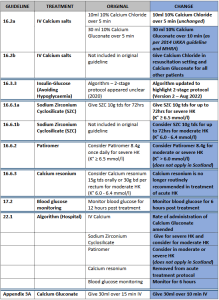
A further update of this guideline has been undertaken following the publication of the NICE guideline (TA1148) in April 2026 pertaining to the use of sodium zirconium cyclosilicate for chronic hyperkalaemia.
The International Liaison Committee on Resuscitation (ILCOR) has also published a review on the treatment of hyperkalaemia in 2025. The evidence for use of IV calcium is poor and ILCOR have found no evidence for or against its use. On this basis, the GRADING of evidence assigned to the UKKA guideline has been amended.
Hyperkalaemia is a medical disorder in which the potassium (K+) level in the blood is raised. The kidneys are largely responsible for removing K+ from the body, therefore the most common cause of hyperkalaemia is impaired kidney function. Some commonly prescribed drugs used to treat heart failure, kidney disease
and diabetes mellitus can also contribute to hyperkalaemia, therefore this guideline provides guidance for initiation, monitoring and strategies for dose optimisation to improve patient outcomes.
Purpose
This guideline provides an updated version of the 2020 UKKA Hyperkalaemia guideline. The main aims are to provide evidence-based recommendations for the treatment of chronic hyperkalaemia in the community, acute hyperkalaemia in the hospital setting and to reduce the risk of complications associated with hyperkalaemia itself and its treatment.
There is no universally accepted definition of hyperkalaemia. This guideline has adopted the European Resuscitation Council (ERC) Guideline definition with a threshold serum potassium (K+) level of ≥ 5.5 mmol/l, established in 2005 1 and maintained to current date.2 It is further classified by severity into mild (5.5-5.9 mmol/l), moderate (6.0-6.4 mmol/l) or severe (≥ 6.5 mmol/l).
Hyperkalaemia is a common medical emergency when it presents acutely. The presence of persistent hyperkalaemia in the community is often regarded as chronic, usually in the context of drugs that exacerbate the condition.
Table 1: Risk factors with odds ratio of developing hyperkalaemia in community studies.
Table 2: Prevalence and outcome of hyperkalaemia in patients with eGFR> 60 ml/min in community studies.
Table 3: Prevalence of hyperkalaemia and mortality rate in patients with CKD.
Table 4: NICE CKD Guideline (2021) – Minimum number of monitoring visits per year.
Figure 1: Progressive changes in ECG with increasing severity of hyperkalaemia.
Figure 2: ECG in a patient with severe hyperkalaemia (serum K+ 9.1 mmol/l) illustrating peaked T waves (a),diminished P waves (b) and wide QRS complexes (c).
Figure 3: Arrhythmias in patients with severe hyperkalaemia illustrating bradycardia with wide QRS [K+ 9.6 mmol/L] (a), sine wave with pause [K+ 9.3 mmol/L] (b) and sine wave without pause [K+ 8.4 mmol/L] (c) and ventricular tachycardia [K+ 9.1 mmol/L] (d).
The UK Kidney Association encourages non-renal specialties to record audit measures for all patients diagnosed with hyperkalaemia irrespective of whether or not they are referred to renal services. Hospital laboratories should be capable of providing data to help audit compliance with these guidelines. It is recommended that the following audit measures be recorded for patients with hyperkalaemia.
I. Hyperkalaemia in the Community (Guidelines 1.1 12.1)
Introduction
The term ‘chronic hyperkalaemia’ generally refers to persistent mild-moderate hyperkalaemia in clinically well patients in the community. There is no consensus on the magnitude, duration, and frequency of elevated potassium (K+) levels that define chronicity. Chronic hyperkalaemia is clinically important as it can interfere with the management of many medical conditions.
II. Hyperkalaemia in Hospital
Introduction
Hyperkalaemia is a potentially life-threatening medical emergency. The incidence in hospitalised patients ranges from 1 10%.1-5 It is associated with increased hospitalisation and mortality,6-9 and the risk of death increases with worsening severity of hyperkalaemia.10 Patients with a diagnosis of heart failure, CKD/ESRD, AKI or type 2 diabetes have a 28.9% relative increase of prevalence of hyperkalaemia and a 4% higher inpatient mortality.11 The higher prevalence of hyperkalaemia in this patient population is largely attributable to the widespread use of RAASi drugs for cardiorenal protection.
III: Hyperkalaemia in Resuscitation
Introduction
Hyperkalaemia is an uncommon, but potentially reversible cause of cardiac arrest. It most often occurs in patients with pre-existing renal disease or in the context of an AKI. Patients with ESRD receiving long-term haemodialysis (HD) are most at risk of hyperkalaemia. Cardiac arrest can occur in hospital, within an out-patient dialysis unit or out of hospital, but hyperkalaemia should be considered in all settings in patients at risk.
The authors wish to thank Dr Charlie Tomson, retired Consultant Nephrologist and former Chair of the UK Renal Association (2010-2012), who shared our enthusiasm for this project and facilitated the original hyperkalaemia guideline (2014). We wish to thank representatives from the UK Resuscitation Council, Dr Jasmeet Soar and Dr Jerry Nolan, for their collaboration on the original guideline and their ongoing support. We also wish to thank Professor Ketan Dhatariya, Chair of the Joint British Diabetes Society for InPatient Care (JBDS-IP) and Dr Clare Crowley, Consultant Pharmacist (Medicines Saftety) at Oxford University Hospitals.
We are especially grateful to Mr Murdoch MacRury for his insight into the treatment of hyperkalaemia from a patient’s perspective.
The authors have no conflict of interest.
Appendix 1: Efficacy of Insulin-Glucose in treatment of hyperkalaemia
Appendix 2: Oral potassium lowering drugs
Appendix 3: Summary of Clinical Trials of oral potassium lowering drugs
Appendix 4: Drug administration and safety
- Intravenous Calcium – Chloride and Gluconate solutions
- Insulin-glucose infusion
- Salbutamol
- Patiromer
- Sodium zirconium cyclosilicate
- Calcium resonium
Appendix 5: ECG in Hyperkalaemia – sine wave
Appendix 6: Algorithm Management of Hyperkalaemia in the Community
Appendix 7: Algorithm Management of Hyperkalaemia in Hospital
Appendix 8: Algorithm Management of Hyperkalaemia in Resuscitation