
Guideline 10.1 – Sodium Zirconium Cyclosilicate for the management of Hyperkalaemia
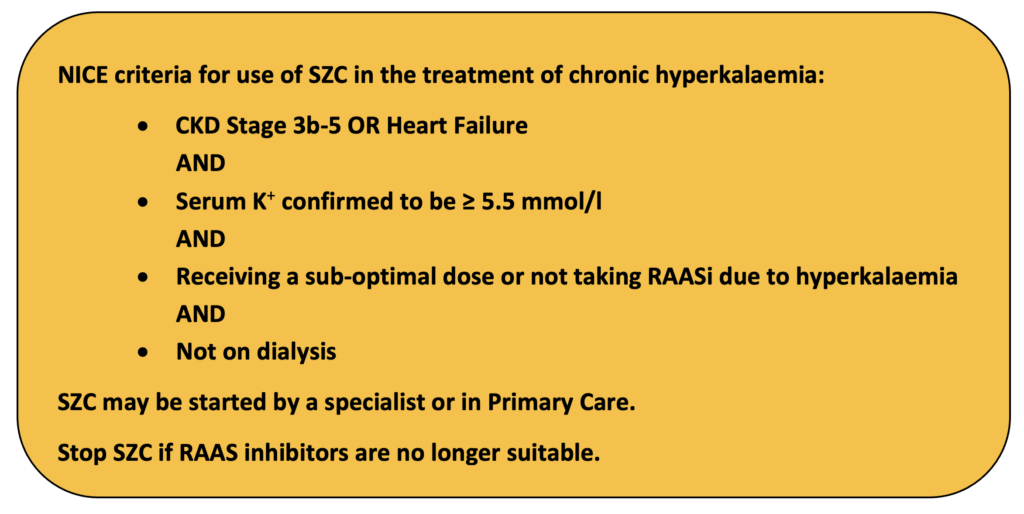
We recommend that Sodium Zirconium Cyclosilicate (SZC) is an option in adults for the management of persistent hyperkalaemia with a confirmed serum K+ ≥ 5.5 mmol/l in patients with CKD Stage 3b-5 (not on dialysis) or heart failure receiving a sub-optimal dose of RAASi therapy. (1A)
Guideline 10.2 – Sodium Zirconium Cyclosilicate for the management of Hyperkalaemia
We recommend that treatment with Sodium Zirconium Cyclosilicate (SZC) in adults is discontinued if RAASi therapy is stopped. (1A)
Guideline 10.3 – Sodium Zirconium Cyclosilicate for the management of Hyperkalaemia
We recommend that Sodium Zirconium Cyclosilicate (SZC) may be initiated in Primary or Secondary Care to support RAASi optimisation. (1A)
Audit measures
- The proportion of adults with mild (serum K+5 – 5.9 mmol/l) and moderate hyperkalaemia (serum K+ 6.0 – 6.4 mmol/l) treated with SZC who achieved a serum K+ ≤ 5.0 mmol/l within 48 hours in the out-patient setting.
- The proportion of adults who achieve maximal dose RAASi therapy after initiation of SZC in the outpatient setting.
Rationale (Guideline 10.1 – 10.3)
Sodium Zirconium Cyclosilicate (SZC) is a non-absorbed K+ binder that preferentially exchanges H+ and Na+ for K+ and ammonium ions throughout the entire gastrointestinal tract.1 SZC selectively entraps monovalent cations (i.e. K+ and ammonium) compared with divalent cations (Ca2+ and Mg2+). Therefore, unlike patiromer, SZC does not affect Mg2+ levels. SZC binding of ammonium ions increases serum bicarbonate levels, which is favourable in the context of hyperkalaemia. In vitro studies have shown that the K+ binding capacity of SZC is up to 9 times greater than that of sodium polystyrene sulphonate (SPS).2 The K+ exchange capacity of SZC is also > 25 times more selective for K+ over Ca2+ or Mg2+ compared with SPS.3 A comparison of the mechanism of action of all oral K + binders is shown in Appendix 2.
SZC is generally well tolerated. The most common adverse effects are oedema (5.7%) and hypokalaemia (4.1%). SZC exchanges Na+ for K+, accounting for the potential risk of worsening oedema, hypertension and heart failure. Product information is described in Appendix 4E.
Evidence base for SZC for chronic hyperkalaemia
Initial studies included three randomised controlled trials and one open-label clinical trial. The first was a double blind RCT (2015) to investigate the safety and efficacy of SZC across a range of doses over a 2-day period.4 A dose-dependent reduction in serum K+ was demonstrated. The primary endpoint of rate of decline of serum K+ was achieved at a dose of 10g three times daily.
Table 8: Studies of the efficacy of SZC in treatment of Hyperkalaemia
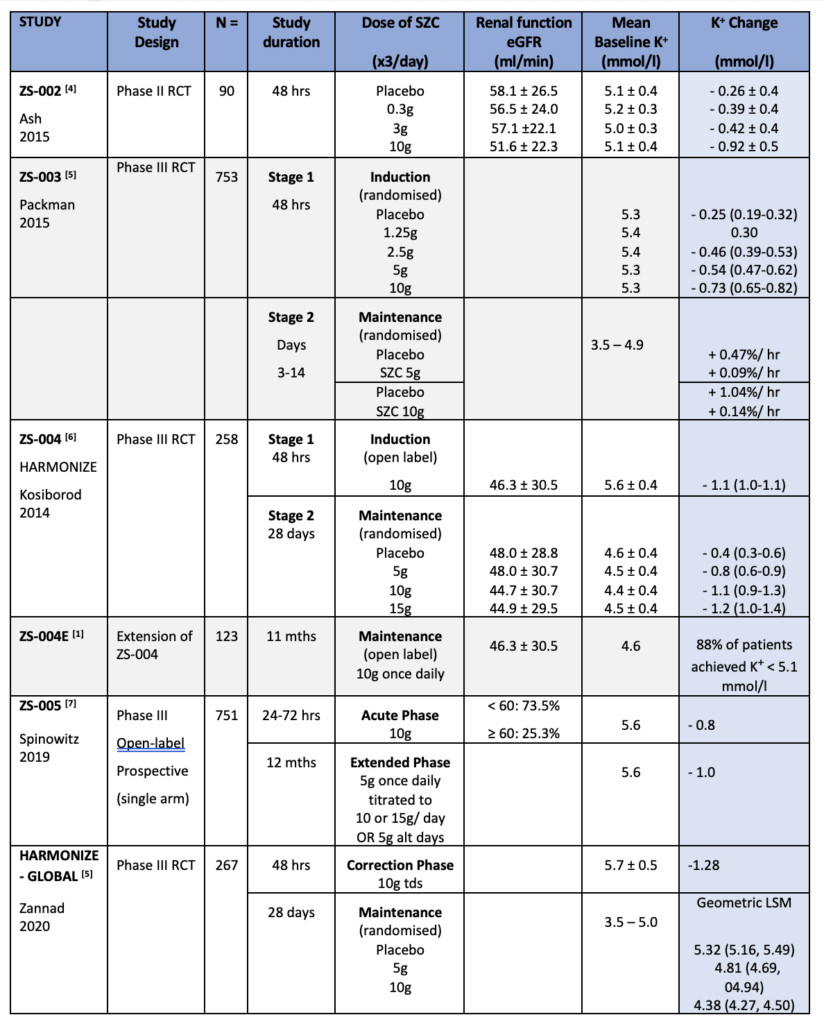
This was followed by two multinational Phase III RCT trials (ZS 003, ZS 004) to evaluate the efficacy and safety of SZC over a longer duration.5,6 ZS 005 investigated efficacy of SZC over 52 weeks.7 Patients with CKD, heart failure, diabetes mellitus and receiving RAASi medication were included in these studies. The studies were conducted in stable out patients and excluded patients on dialysis, with life threatening hyperkalaemia or diabetic ketoacidosis. There was also no restriction on dietary K⁺ intake in all of SZC trials.
The key clinical trials for SZC in the treatment of hyperkalaemia are summarised in Table 8. These studies were designed to determine the efficacy of SZC in controlling hyperkalaemia over a 48 hr induction phase, followed by sustained control during a maintenance phase of variable duration – 14 days (ZS 003), 28 days (ZS 004) and 52 weeks (ZS 005). The proportion of patients with CKD, diabetes, heart failure and taking RAASi drugs were similar in these studies (see Appendix 3).
These clinical trials have demonstrated the efficacy of SZC. The onset of action of SZC is within 1 hour after ingestion and there is a close correlation between the initial serum K⁺ level and the size of the treatment effect.1 The median time to normalisation of serum K⁺ was 2.2 hours.6 SZC lowers serum K⁺ by 1.1 mmol/l within 48 hours.6 The ZS 003 and ZS 004 clinical trials also demonstrated a greater K⁺ lowering effect with increasing severity of hyperkalaemia.5,6 In patients with a serum K⁺ > 6.0 mmol/l, SZC lowers serum K⁺ by 1.5 mmol/l within 48 hours.6 In the longterm study conducted over 12 months, 87% of patients were able to continue RAASi or increase the dose and only 11% discontinued RAASi therapy.7
A meta analysis of the SZC trials (2017) have shown that it lowers serum K⁺ by 0.17 mmol/l at 1 hour and 0.67 mmol/l at 48 hours after administration.9 In a subgroup analysis of patients with a baseline serum K⁺ ranging from 6.1 – 7.2 mmol/l, SZC lowered serum K⁺ by a mean of 0.4 mmol/l at 1 hour after administration of 10g dose.10 In the HARMONIZE Global study, significantly more patients achieved normokalaemia with SZC 5mg (58.6%) and SZC 10mg (77.3%) compared with placebo (24%).8
Roger et al (2021) conducted a Phase 3 study (n=751) to assess the long term safety and efficacy of SZC in patients with mild moderate vs severe end stage CKD.11 During the correction phase, 82% of patients achieved normokalaemia in both eGFR groups within 24 hours. By 72 hours, 100% of patients with a baseline eGFR <30ml/min and 95% of patients with a baseline eGFR ≥ 30 ml/min achieved normokalaemia suggesting equivalent efficacy across CKD stages.
The OPTIMIZE 1 Study (2023) evaluated RAASi modifications among patients (n=589) who initiated SZC for hyperkalaemia.12 Most patients optimised RAASi dosage (77.4%). Overall, 69.6% maintained the same dose, and 7.8% had up titration of dose after initiating SZC. A similar rate of optimisation was found in patients with CKD (78.9%) and those with CKD + diabetes (78.1%). At 1 year, 73.9% of all patients who optimised RAASi were still on therapy.
Recommendations for use of SZC for chronic hyperkalaemia
NICE[13] and SMC [14] have approved SZC for restricted use as indicated below. The key evidence is that SZC reduces serum K+ in two- and four-week studies. Safety and efficacy have also been shown up to 52 weeks of therapy, but the duration of treatment in clinical practice will likely be lifelong unless RAASi is discontinued. SZC will complement, rather than replace, a modified K+ diet. SZC may allow less strict dietary restrictions, thereby improving quality of life for patients.
NICE[13] considered the SPARK[15, 16] and ZORA[17] studies, which provided some real-world evidence to guide practice.
SPARK was a large UK retrospective observational longitudinal study investigating the relationship between serum potassium and risk of all-cause mortality, hospitalisation and major adverse cardiac outcomes.[15, 16] This study found that patients with CKD (without heart failure) with a K+ ≥ 5.5 mmol/l had a 50% higher all-cause mortality compared with patients with a K+ 4.5 – 5.0 mmol/l. Similarly, patients with heart failure (without CKD) with a K+ ≥ 5.5 mmol/l had a 70% higher all-cause mortality compared with patients with a K+ 4.5 – 5.0 mmol/l.
ZORA demonstrated how sodium zirconium cyclosilicate can potentially facilitate optimisation of RAASI therapy in eligible patients with CKD and heart failure.[17] This study found that a higher proportion of patients with a serum K+ 5.5 – 5.9 mmol/l were able to maintain RAASi therapy with sodium zirconium cyclosilicate versus no K+ binder.
Cochrane review of potassium binders for chronic hyperkalaemia in people with CKD (2020) included 15 studies (n=1849 participants).15 Three of these studies were among patients treated with haemodialysis. Binders included calcium polystyrene sulfonate, sodium polystyrene sulfonate, patiromer, and sodium zirconium cyclosilicate. The certainty of evidence for all outcomes was low. SZC made little to no difference to death.
Blood monitoring for patients treated with SZC for chronic hyperkalaemia
The aim is to achieve the minimum effective dose of SZC to prevent recurrence of hyperkalaemia. The recommended starting dose is 5g once daily, with up titration to a maximum dose of 10g once daily or down titration to 5g alternate days if required (Appendix 4E).1 Dose titration or cessation will be led by secondary care. In real world practice, blood monitoring will shared with primary care, therefore clear guidance or protocols will be necessary.
Based on the ZS 005 trial conducted over 12 months, blood monitoring should be performed weekly for the first month, then monthly thereafter.7 Serum K⁺ should also be assessed one week after drug cessation as a rebound in K⁺ level can occur.
References
- Astra Zeneca. Lokelma (sodium zirconium cyclosilicate) for oral suspension: Summary of Product Characteristics. 2018. ema.europa.eu/ema/
- Yang, A., et al., In Vitro Ion Exchange Capacity and Selectivity of ZS 9, a Novel, Selective Cation Trap for the Treatment of Hyperkalemia. American Journal of Kidney Diseases, 2014. 63(5): p. A115–A115.
- Stavros, F., et al., Characterization of structure and function of ZS 9, a K+selective ion trap. PLoS One, 2014. 9(12): p. e114686.
- Ash, S.R., et al., A phase 2 study on the treatment of hyperkalemia in patients with chronic kidney disease suggests that the selective potassium trap, ZS 9, is safe and efficient. Kidney Int, 2015. 88(2): p. 404–11.
- Packham, D.K., et al., Sodium zirconium cyclosilicate in hyperkalemia. N Engl J Med, 2015. 372(3): p. 222–31.
- Kosiborod, M., et al., Effect of sodium zirconium cyclosilicate on potassium lowering for 28 days among outpatients with hyperkalemia: the HARMONIZE randomized clinical trial. JAMA, 2014. 312(21): p. 2223–33.
- Spinowitz, B.S., et al., Sodium Zirconium Cyclosilicate among Individuals with Hyperkalemia: A 12 Month Phase 3 Study. Clin J Am Soc Nephrol, 2019. 14(6): p. 798–809.
- Zannad, F., et al., Efficacy and safety of sodium zirconium cyclosilicate for hyperkalemia: the randomized, placebo controlled HARMONIZE Global study. ESC Heart Fail, 2020. 7(1): p. 54–64.
- Meaney, C.J., et al., Systematic Review and Meta Analysis of Patiromer and Sodium Zirconium Cyclosilicate: A New Armamentarium for the Treatment of Hyperkalemia. Pharmacotherapy, 2017. 37(4): p. 401–411.
- Bianchi, S. and G. Regolisti, Pivotal clinical trials, meta analyses and current guidelines in the treatment of hyperkalemia. Nephrol Dial Transplant, 2019. 34(Suppl 3): p. iii51–iii61.
- Roger, S.D., et al., Long term safety and efficacy of sodium zirconium cyclosilicate for hyperkalemia in patients with mild/moderate versus severe/end stage chronic kidney disease: comparative results from an open label, Phase 3 study. Nephrol Dial Transplant, 2021. 36(1): p. 137–150.
- Agiro, A., et al., Real World Modifications of Renin Angiotensin Aldosterone System Inhibitors in Patients with Hyperkalaemia Initiating Sodium Zirconium Cyclosilicate Therapy: The OPTIMIZE I Study. Adv Ther, 2023. 40(6): p. 2886–2901.
- National Institute of Clinical Excellence. Sodium Zirconium Cyclosilicate for treating hyperkalaemia. Technology appraisal guidance [TA1148]. Published April 2026. www.nice.org/guidance/TA1148
- Scottish Medicines Consortium. Sodium zirconium cyclosilicate (Lokelma®) is accepted for restricted use within NHSScotland. SMC2288. Sept 2020. https://www.scottishmedicines.org.uk/medicines advice/sodium zirconium cyclosilicate lokelma resub smc2288/
- Poster PB 260, Burton et al., UKKW 2025. Veeva Approval ID: REF-331348. February 2025.
- AstraZeneca. Data on File. Veeva Approval ID: REF-286448 September 2025.
- AstraZeneca. Data on File. Veeva Approval ID: REF-290354 March 2025.
- Natale, P., et al., Potassium binders for chronic hyperkalaemia in people with chronic kidney disease. Cochrane Database Syst Rev, 2020. 6(6): p. CD013165.