
I. Hyperkalaemia in the Community (Guidelines 1.1 – 12.1)
Introduction
The term ‘chronic hyperkalaemia’ generally refers to persistent mild moderate hyperkalaemia in clinically well patients in the community. There is no consensus on the magnitude, duration, and frequency of elevated potassium (K+) levels that define chronicity. Chronic hyperkalaemia is clinically important as it can interfere with the management of many medical conditions.
Mechanisms contributing to hyperkalaemia in patients with CKD include reduced aldosterone effect, reduced potassium cell uptake, and reduced delivery of sodium and water in the distal tubules.
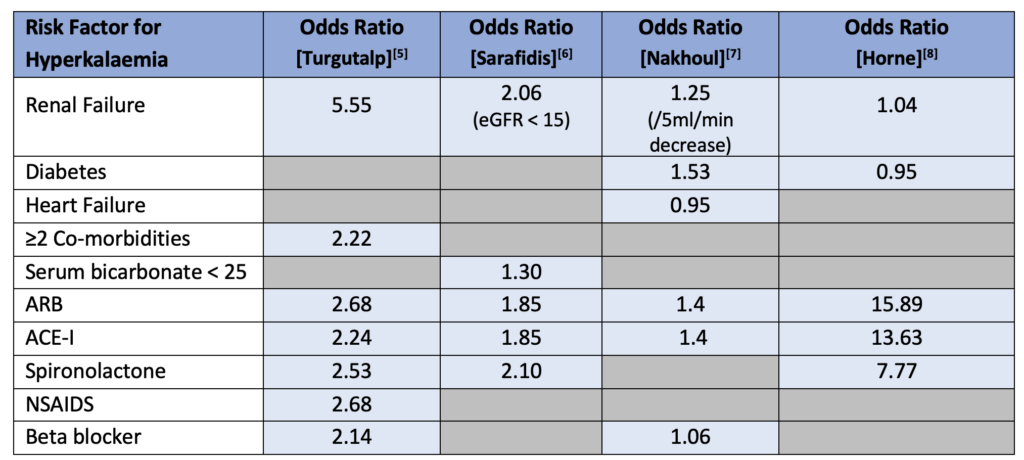
Patient groups most at risk are those with CKD, diabetes mellitus, and heart failure. Hyperkalaemia develops in approximately 10% of outpatients within one year after initiation of RAASi drugs, thereby limiting treatment in the patients who receive the greatest benefit from this therapy.
The presence of multiple co-morbidities or other risk factors further increases the risk of hyperkalaemia.
The management of patients with heart failure is challenging given the high prevalence of renal impairment. In clinical trials of RAASi monotherapy, the incidence of hyperkalaemia ranges from 3 7%. The overall incidence of hyperkalaemia was generally higher in clinical trials involving aldosterone antagonists. Combination therapy of RAASi and aldosterone antagonist increases the risk of hyperkalaemia and hospitalisation.
Table 1: Risk factors with odds ratio of developing hyperkalaemia in community studies.
Incidence of hyperkalaemia in the Community
The reported incidence of hyperkalaemia in the general population is variable depending on the specific patient group, study design, level of renal function, and definition of hyperkalemia 5,8,11 15. The prevalence of hyperkalaemia in patients with an eGFR > 60 ml/min is shown in Table 2. In a large UK primary care UKKA Clinical Practice Guideline – Management of Hyperkalaemia in Adults – October 2023 21st udy, the overall incidence rate of a hyperkalaemic event was 2.9 per 100 person years.8 In this study, the use of RAASi was strongly associated with hyperkalaemia with an odds ratio of 13.6 15.9.
Table 2: Prevalence and outcome of hyperkalaemia in patients with eGFR> 60 ml/min in community studies.
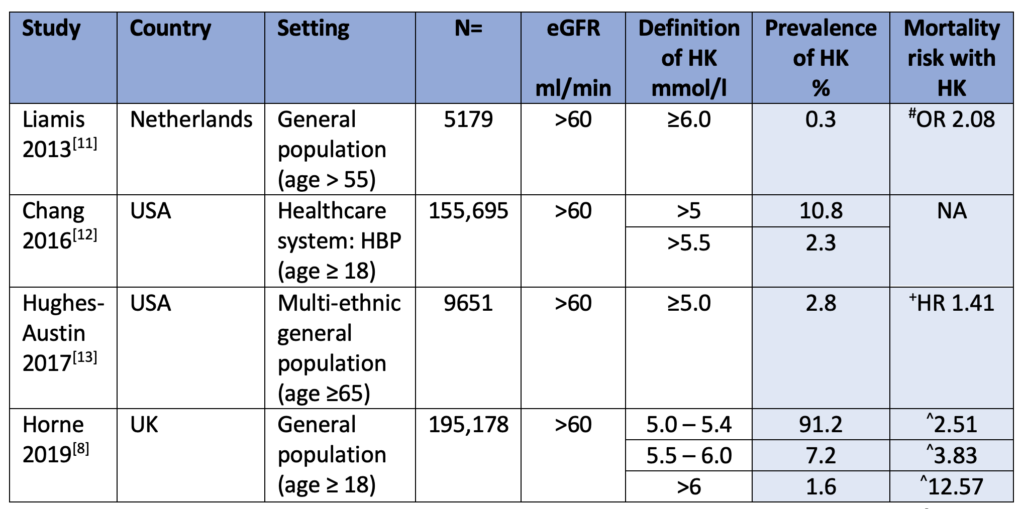
OR Odds Ratio; + HR Hazard Ratio; ^ All cause mortality; HBP – hypertensive; NA – not available
Hyperkalaemia is more common in patients with CKD, and the incidence increases with declining renal function. Over 30% of patients with eGFR < 15 ml/min have experienced hyperkalaemia (K+ > 5.5 mmol/l) in the pre dialysis setting (eGFR < 15 ml/min).6 6 A summary of the prevalence of hyperkalaemia in patients with CKD is shown in Table 3.
Table 3: Prevalence of hyperkalaemia and mortality rate in patients with CKD.
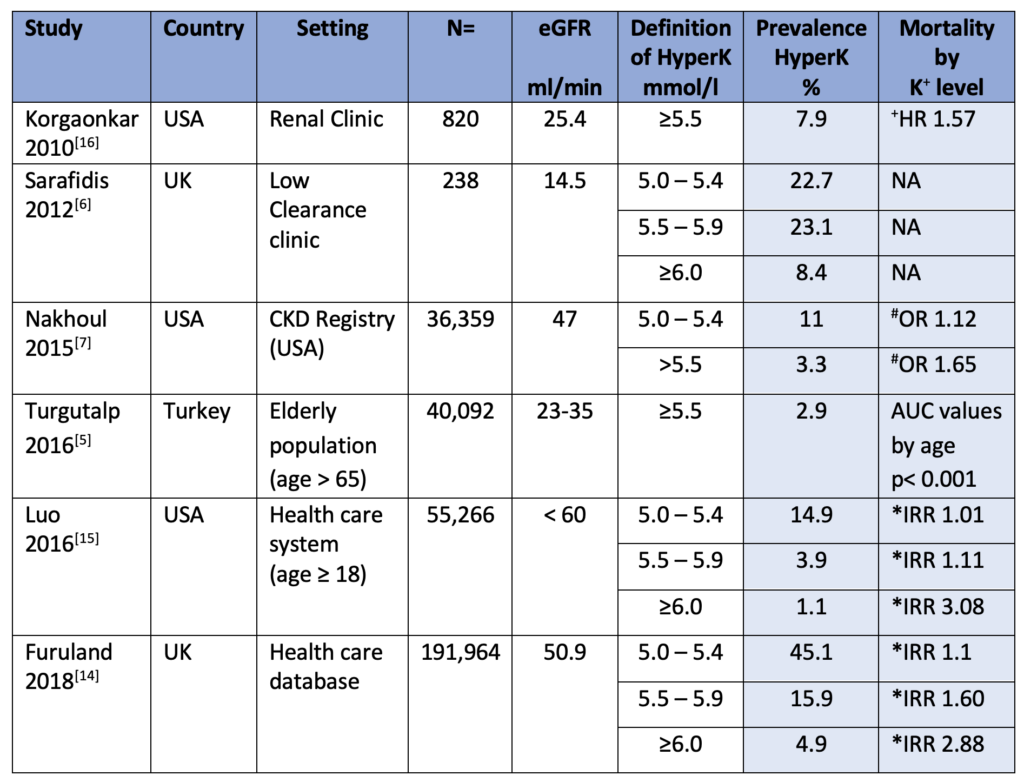
NA – not available; + HR – Hazard Ratio; # OR Odds Ratio; AUC Area Under Curve; *IRR Incident rate ratio
Impact of chronic hyperkalaemia
Hyperkalaemia is associated with interruptions to medical therapies (i.e., RAASi and MRA), increased hospitalisation, prolongation of hospital stay, increased healthcare costs, and increased mortality.
Mortality increases with worsening severity of hyperkalaemia in the general population and in patients with CKD. Mortality in patients with heart failure has been shown to increase significantly with worsening severity of hyperkalaemia: serum K+ levels between 4.8 – 5.0 mmol/l (HR 1.34), 5.1 – 5.5 mmol/l (HR 1.60) and 5.6 – 7.4 mmol/l (HR 3.31).
This chapter focuses on the detection, treatment, and prevention of hyperkalaemia in the community. It will address the management of patients receiving RAASi drugs, indications for hospital admission, and the use of novel oral potassium-lowering drugs.
References
1. Clase, C.M., et al., Potassium homeostasis and management of dyskalemia in kidney diseases: conclusions from a Kidney Disease: Improving Global Outcomes (KDIGO) Controversies Conference. Kidney Int, 2019.
2. Borrelli, S., et al., Chronic Hyperkaliemia in Chronic Kidney Disease: An Old Concern with New Answers. Int J Mol Sci, 2022.
3. Maggioni, A.P., et al., Prevalence, clinical impact, and costs of hyperkalaemia: Special focus on heart failure. Eur J Clin Invest, 2021.
4. Palmer, B.F. and D.J. Clegg, Diagnosis and treatment of hyperkalemia. Cleve Clin J Med, 2017.
5. Turgutalp, K., et al., Community acquired hyperkalemia in elderly patients: risk factors and clinical outcomes. Ren Fail, 2016.
6. Sarafidis, P.A., et al., Prevalence and factors associated with hyperkalemia in predialysis patients followed in a low clearance clinic. Clin J Am Soc Nephrol, 2012.
7. Nakhoul, G.N., et al., Serum Potassium, End Stage Renal Disease and Mortality in Chronic Kidney Disease. Am J Nephrol, 2015.
8. Horne, L., et al., Epidemiology and health outcomes associated with hyperkalemia in a primary care setting in England. BMC Nephrol, 2019.
9. Tromp, J. and P. van der Meer, Hyperkalemia: aetiology, epidemiology, and clinical significance. Eur Heart J Suppl, 2019.
10. Juurlink, D.N., et al., Rates of hyperkalemia after publication of the randomized aldactone evaluation study. New England Journal of Medicine, 2004.
11. Liamis, G., et al., Electrolyte disorders in community subjects: prevalence and risk factors. Am J Med, 2013.
12. Chang, A.R., et al., Antihypertensive Medications and the Prevalence of Hyperkalemia in a Large Health System. Hypertension, 2016.
13. Hughes Austin, J.M., et al., The Relation of Serum Potassium Concentration with Cardiovascular Events and Mortality in Community Living Individuals. Clin J Am Soc Nephrol, 2017.
14. Furuland, H., et al., Serum potassium as a predictor of adverse clinical outcomes in patients with chronic kidney disease: new risk equations using the UK clinical practice research datalink. BMC Nephrol, 2018.
15. Luo, J., et al., Association between Serum Potassium and Outcomes in Patients with Reduced Kidney Function. Clin J Am Soc Nephrol, 2016.
16. Korgaonkar, S., et al., Serum potassium and outcomes in CKD: insights from the RRI CKD cohort study. Clin J Am Soc Nephrol, 2010.
17. Leon, S.J., et al., Hyperkalemia Related Discontinuation of Renin Angiotensin Aldosterone System Inhibitors and Clinical Outcomes in CKD: A Population Based Cohort Study. Am J Kidney Dis, 2022.
18. Aldahl, M., et al., Associations of serum potassium levels with mortality in chronic heart failure patients. Eur Heart J, 2017.