
Systematic Search Design
The systematic search was designed using a multi-stage process to maximise sensitivity to small trials (irrespective of recruitment of individuals with kidney disease) and to permit the inclusion of additional populations of interest in future iterations of the clinical guideline. To achieve this, database search queries and inclusion criteria were designed to be broad and sensitive to give a comprehensive summary of the relevant literature.
Searches were designed primarily to identify randomized controlled trials (RCTs) (1). However, where relevant, meta-analyses of trials and pooled analyses of such trials were identified from systematic searches. Stages of systematic search were:
- Database search and exclusion of non-relevant article types through abstract review
- Identification of all trials randomizing participants to SGLT-2 inhibition by full-text review
- Identification of specific randomized trials of interest based on pre-defined inclusion criteria by full- text review
- Identification of relevant meta-analyses from the systematic search
- Provision of literature to working groups
Trials of interest
Pre-determined trials of interest identified for this guideline map to the guideline sections as follows:
- Large, placebo-controlled RCTs (comprising evidence for sections 2, 3, and 5 of the guideline)
- RCTs conducted in people with type 1 diabetes mellitus (DM) (mapping to section 7a of the guideline)
- RCTs conducted in kidney transplant recipients (mapping to section 7b of the guideline)
- RCTs conducted in people with heart failure with preserved ejection fraction (HFpEF, mapping to section 7c of the guideline)
Trials meeting primary eligibility criteria but not meeting criteria for studies of interest were documented and stored, creating a repository of relevant trials that can be interrogated in future iterations of the guideline for the use of SGLT-2 inhibitors.
Inclusion and exclusion criteria
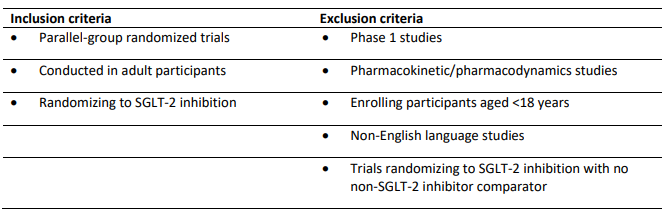
Inclusion of identified records was mapped to broad inclusion and exclusion criteria as summarised in Appendix Table 1. Inclusion criteria for studies of interest are detailed in Appendix Table 2.
Risk of bias
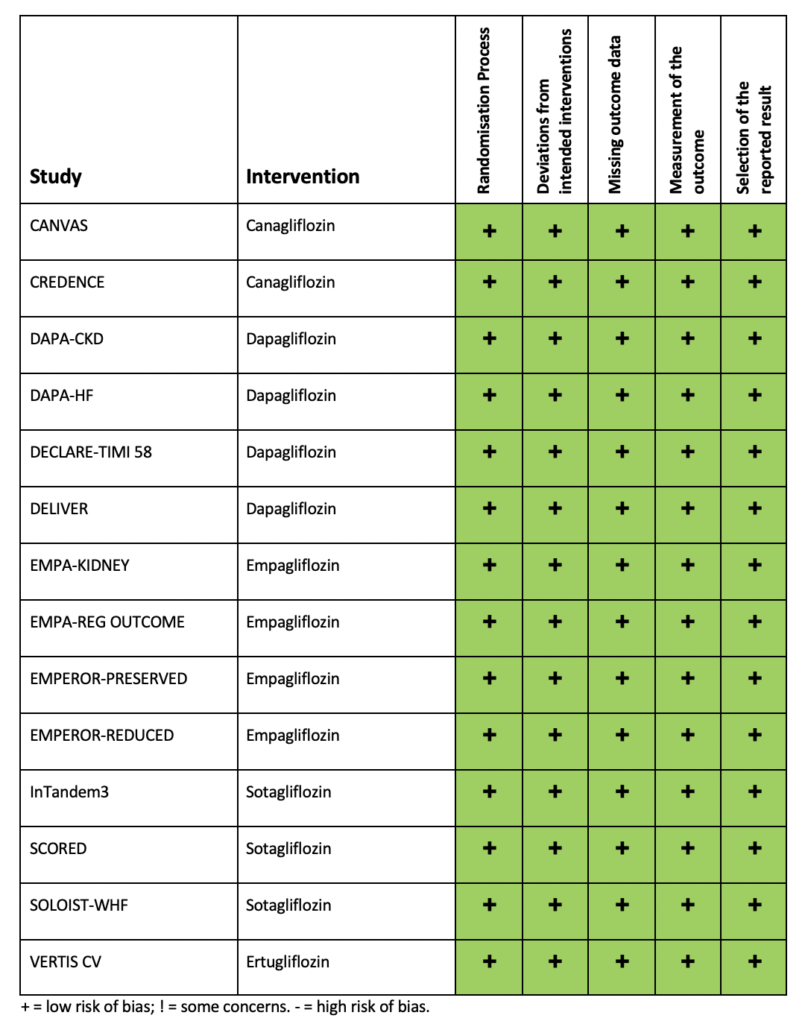
Risk of bias of primary studies of interest (comprising large placebo-controlled randomised controlled trials) was assessed using the Cochrane Risk of Bias 2 tool (2). All studies were reviewed by two reviewers (AW, AR, AK) independently and in duplicate.
Appendix Table 1: Primary eligibility criteria
Appendix Table 2: Inclusion criteria for specific studies of interest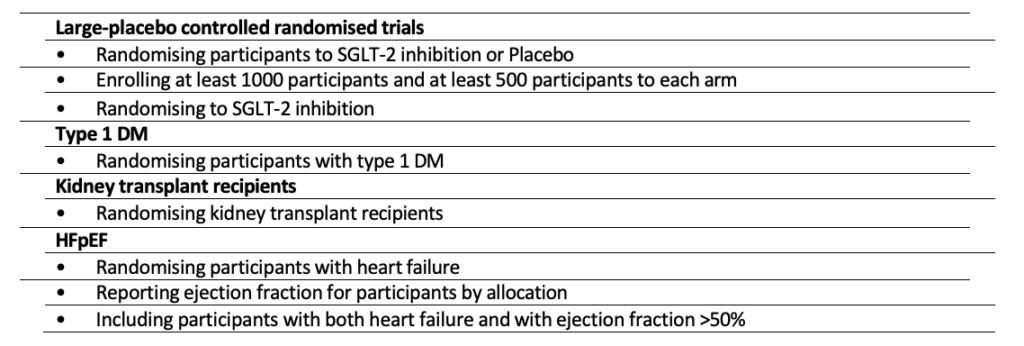
Database search strategy
The Medline and Embase databases were searched on 16th February 2021 via OVID. The database search was designed to identify a) RCTs (identified using validated search filters obtained from the Cochrane Handbook of Systematic Reviews), and b) studies in SGLT-2 inhibition. The full search criteria are detailed in Appendix Tables 3 & 4.
Appendix Table 3: Search strategy for Embase (Via OVID).
Embase search strategy
- Randomized controlled trial/
- Controlled clinical study/
- random$.ti,ab.
- randomization/
- intermethod comparison/
- placebo.ti,ab.
- (compare or compared or comparison).ti.
- ((evaluated or evaluate or evaluating or assessed or assess) and (compare or compared or comparing or comparison)).ab.
- (open adj label).ti,ab.
- ((double or single or doubly or singly) adj (blind or blinded or blindly)).ti,ab
- double blind procedure/
- parallel group$1.ti,ab.
- (crossover or cross over).ti,ab.
- ((assign$ or match or matched or allocation) adj5 (alternate or group$1 or intervention$1 or patient$1 or subject$1 or participant$1)).ti,ab.
- (assigned or allocated).ti,ab.
- (controlled adj7 (study or design or trial)).ti,ab.
- (volunteer or volunteers).ti,ab.
- human experiment/
- trial.ti.
- 1 or 2 or 3 or 4 or 5 or 6 or 7 or 8 or 9 or 10 or 11 or 12 or 13 or 14 or 15 or 16 or 17 or 18 or 19 21 (random$ adj sampl$ adj7 (“cross section$” or questionnaire$1 or survey$ or database$1)).ti,ab. not (comparative study/ or controlled study/ or randomi?ed controlled.ti,ab. or randomly assigned.ti,ab.)
- Cross-sectional study/ not (randomized controlled trial/ or controlled clinical study/ or controlled study/ or randomi?ed controlled.ti,ab. or control group$1.ti,ab.)
- (((case adj control$) and random$) not randomi?ed controlled).ti,ab.
- (Systematic review not (trial or study)).ti.
- (nonrandom$ not random$).ti,ab.
- “Random field$”.ti,ab.
- (random cluster adj3 sampl$).ti,ab.
- (review.ab. and review.pt.) not trial.ti.
- “we searched”.ab. and (review.ti. or review.pt.)
- “update review”.ab.
- (databases adj4 searched).ab.
- (rat or rats or mouse or mice or swine or porcine or murine or sheep or lambs or pigs or piglets or rabbit or rabbits or cat or cats or dog or dogs or cattle or bovine or monkey or monkeys or trout or marmoset$1).ti. and animal experiment/
- Animal experiment/ not (human experiment/ or human/)
- 21 or 22 or 23 or 24 or 25 or 26 or 27 or 28 or 29 or 30 or 31 or 32 or 33
- 20 not 34
- exp Sodium-Glucose Transporter 2 Inhibitors/
- sglt2.tw.
- sglt-2.tw.
- exp Sodium-Glucose Transporter 2/
- sodium-glucose transporter$.tw.
- sodium-glucose co-transporter$.tw.
- sodium-glucose cotransporter$.tw
- (canagliflozin$ or dapagliflozin$ or empagliflozin$ or ertugliflozin$ or ipragliflozin$ or luseogliflozin$ or remogliflozin$ or sergliflozin$ or sotagliflozin$ or tofogliflozin$).tw.
- 36 or 37 or 38 or 39 or 40 or 41 or 42 or 43
- 35 and 44
Searches 1-35 comprise the sensitive Embase RCT filter derived from the Cochrane Handbook of Systematic Reviews of Interventions (1).
Appendix Table 4: Search strategy for Medline (Via OVID)
- randomized controlled trial.pt.
- controlled clinical trial.pt.
- randomized.ab.
- placebo.ab.
- clinical trials as topic.sh.
- randomly.ab.
- trial.ti.
- 1 or 2 or 3 or 4 or 5 or 6 or 7
- exp animals/ not humans.sh.
- 8 not 9
- exp Sodium-Glucose Transporter 2 Inhibitors/
- sglt2.tw.
- sglt-2.tw
- exp Sodium-Glucose Transporter 2/
- sodium-glucose transporter$.tw.
- sodium-glucose co-transporter$.tw.
- sodium-glucose cotransporter$.tw.
- (canagliflozin$ or dapagliflozin$ or empagliflozin$ or ertugliflozin$ or ipragliflozin$ or luseogliflozin$ or remogliflozin$ or sergliflozin$ or sotagliflozin$ or tofogliflozin$).tw.
- 11 or 12 or 13 or 14 or 15 or 16 or 17 or 18
- 10 and 19
Searches 1-10 comprise the highly-sensitive Medline RCT filter derived from the Cochrane Handbook of Systematic Reviews of Interventions (1).
Stage 1 – abstract and title screening
Citations including abstracts and relevant record details were downloaded and stored in a dedicated database. Duplicate studies were digitally identified and excluded. Remaining records were screened for relevance using the title and abstract against the primary eligibility criteria (Appendix Table 1) by a single reviewer (AJR). Excluded records were categorised based on the reason for exclusion.
Stages 2 and 3 – full-text identification of relevant trials
Remaining records not excluded through abstract and title screening were exported to an Excel spreadsheet to facilitate rapid review by participating reviewers (AJR, WH, SB, AR, AK, AW). The Excel spreadsheet was piloted by all reviewers prior to use. Records were divided between reviewers such that each record was reviewed by two reviewers independently and in duplicate. Records were reviewed for relevance against the primary eligibility criteria (Appendix Table 1). Where studies were included, they were categorised against the inclusion criteria for studies of interest (Appendix Table 2). Any disagreements between reviewers regarding inclusion of a record, or categorisation of records against the inclusion criteria for studies of interest, were resolved by a third reviewer independently (WH).
For all included studies of interest, multiple records of the same trial were reconciled by reference to study acronym, where present, or trial registration database number (e.g. National Clinical Trials [NCT] database number).
Stage 4 – identification of relevant meta-analyses
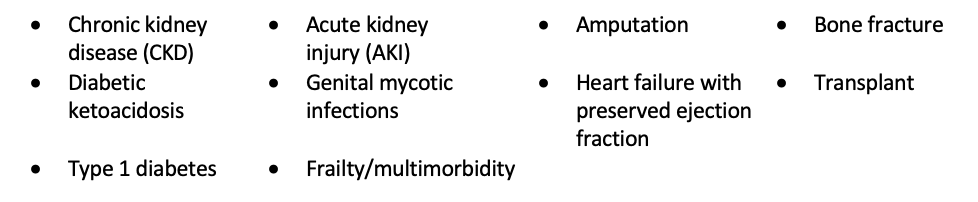
Meta-analyses identified at the abstract/title screening stage or at full-text review stage were screened for relevance by a single reviewer. Meta-analyses were considered relevant if they provided data on the following domains:
Stage 5 – provision of literature to working groups
Listings of all the relevant publications were distributed to the guideline working groups to inform meeting materials and discussion. From review of the relevant literature, evidence-based guidelines were proposed and agreed upon by consensus discussion.
Stage 6 – Updated literature search following publication of EMPEROR-PRESERVED
The systematic review was updated on to 28th August 2021 following the publication of EMPEROR-PRESERVED in order to identify any new large trial primary or subsidiary publications. The result of the updated literature search is formally documented in Appendix Figure 1’s footnote (and elsewhere (3)). New subsidiary publications were reviewed for relevance by AJR & WH.
2023 UPDATED SEARCH
The database search for the 2023 update was undertaken on 5th September 2022 using the same methodology and search terms as prior iterations of the guideline (as described above). Records identified in the updated search were added to the database and duplicates removed. Newly identified large placebo-controlled trials (DELIVER and EMPA-KIDNEY) were subject to risk of bias assessment as described above, and were found to be low risk in all domains. A summary of the updated search is listed in Appendix Figure 2. Risk of bias assessment for large placebo-controlled RCTs can be found in Appendix Figure 3.
Appendix Figure 1: Summary of systematic search results

Appendix Figure 2: Updated systematic search results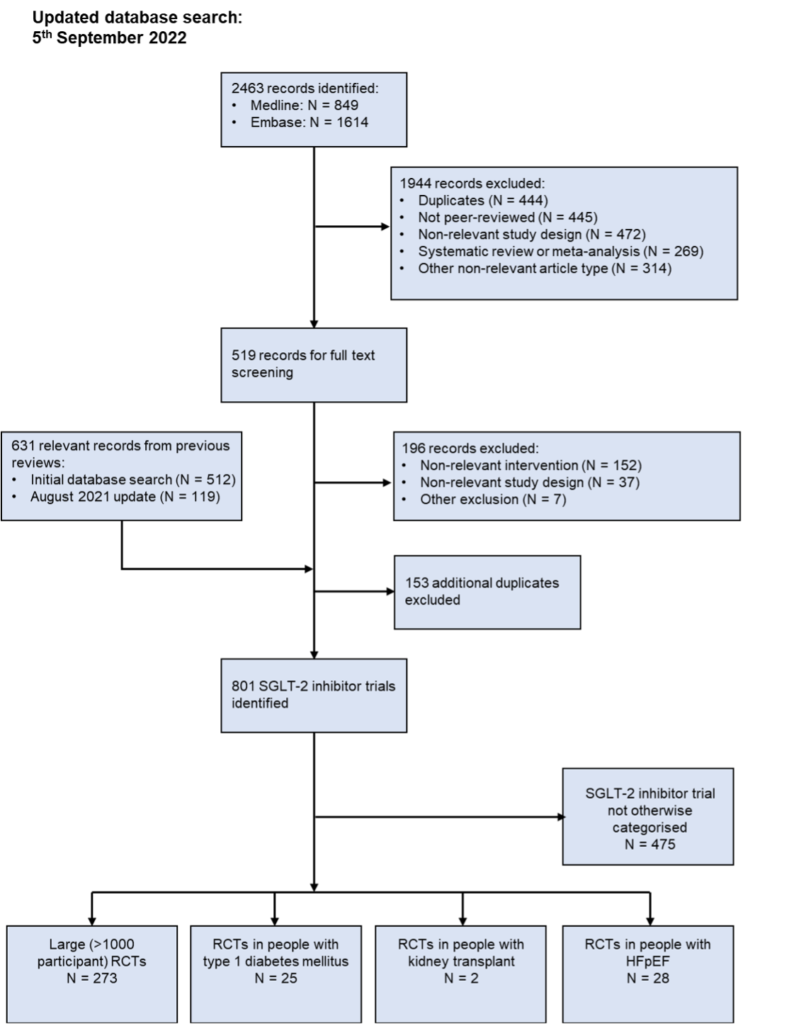
Appendix Figure 3: Risk of bias assessment
Appendix I References
- Higgins JPT, Thomas J, Chandler J, Cumpston M, Li T, Page MJ, Welch VA (editors). Cochrane Handbook for Systematic Reviews of Interventions version 6.3 (updated February 2022). Cochrane, 2022. Available from www.training.cochrane.org/handbook.
- Sterne JAC, Savović J, Page MJ, Elbers RG, Blencowe NS, Boutron I, et al. RoB 2: a revised tool for assessing risk of bias in randomised trials. BMJ. 2019;366:l4898.
- Staplin N, Roddick AJ, Emberson J, Reith C, Riding A, Wonnacott A, et al. Net effects of sodium-glucose co-transporter-2 inhibition in different patient groups: a meta-analysis of large placebo-controlled randomized trials. EClinicalMedicine. 2021;41:101163.
- Kosiborod MN, Esterline R, Furtado RHM, Oscarsson J, Gasparyan SB, Koch GG, et al. Dapagliflozin in patients with cardiometabolic risk factors hospitalised with COVID-19 (DARE-19): a randomised, double-blind, placebo-controlled, phase 3 trial. Lancet Diabetes Endocrinol. 2021;9(9):586-94.