
3.1.2 Summary of trial evidence on kidney disease progression
The large-scale placebo-controlled trials of SGLT-2 inhibitors were not powered to assess effects on kidney disease progression in people without DM considered in isolation (see Table 1.1 in section 1). Information on the efficacy and safety of SGLT-2 inhibitors in people without DM is currently reliant on subgroup analyses of the large SGLT-2 inhibitor trials, with the evidence for CKD provided by DAPA-CKD and EMPA-KIDNEY (1, 4). Interpretation of subgroup analyses mandates additional considerations due to their more limited power compared to any primary assessment, the potential for multiplicity of testing to increase the likelihood of chance findings, and where relevant, their post-hoc nature. One advised approach to address some of these issues is statistical tests for effect modification. These assess whether or not the overall trial result for a given outcome is significantly different in a subgroup, and are often referred to as heterogeneity or interaction tests. In the absence of statistical evidence for heterogeneity, the most reliable quantitative estimate of the relative effect of the test intervention is the overall relative risk, with little weight given to relative risks calculated directly from a subgroup of participants considered in isolation. Despite such approaches, cautious interpretation is still required in underpowered situations. Further examples of considerations on subgroup analyses are provided in this introductory review (5).
Kidney disease progression results from DAPA-CKD
DAPA-CKD recruited people with albuminuric CKD with and without type 2 DM. Kidney-related inclusion criteria were an eGFR 25-75 mL/min/1.73m2 plus a urinary albumin-to-creatinine ratio (uACR) of 200-5000 mg/g (23-566 mg/mmol) on a stable dose of an angiotensin-converting enzyme inhibitor (ACEi) or angiotensin-II receptor blockade (ARB) for ≥4 weeks. Key exclusion criteria were polycystic kidney disease, lupus nephritis, or anti- neutrophil cytoplasmic antibody (ANCA) associated vasculitis, and immunotherapy for kidney disease within 6 months before enrolment (6). DAPA-CKD randomised 4304 people to dapagliflozin 10mg versus matching placebo, including 1398 (32%) without DM. Overall, mean eGFR was 43 mL/min/1.73m2 with ~1 gram per day of albuminuria (median uACR=949 mg/g [107 mg/mmol]) and 97% prescribed an ACEi or ARB. Those without DM had similar levels of eGFR and albuminuria to those with DM, but represented a much wider range of primary kidney diagnoses (Table 3.1) (4, 6).
Table 3.1: Kidney-related characteristics of DAPA-CKD and EMPA-KIDNEY participants by DM status (1, 3, 4, 6, 7)

DAPA-CKD was stopped early due to efficacy, with allocation to dapagliflozin reducing its primary cardiorenal composite outcome (a sustained 50% decline in eGFR, ESKD, or death from renal or cardiovascular causes) by 39% compared to placebo (197/2152 vs 312/2152: hazard ratio [HR]=0.61, 95% confidence interval [CI] 0.51- 0.72). This included a 44% reduction in the risk of the kidney disease progression component of this composite (142 vs 243: HR=0.56, 95%CI 0.45-0.68) and a 34% reduction in the risk of initiation of maintenance dialysis, receipt of a kidney transplant or a renal death (71 vs 103: HR=0.66, 95%CI 0.49- 0.90). Importantly, the relative risk reductions for the primary outcome were similar when analyses were performed separately in people with and without DM, and between eGFR and uACR subgroupings, with nominally significant relative risk reductions in each of these subgroups (all heterogeneity test p>0.05) (4).
Kidney disease progression results from EMPA-KIDNEY
EMPA-KIDNEY enrolled a broad range of participants with CKD at risk of progression (7). Participants were required to have either an eGFR of 20-45 mL/min/1.73m2 irrespective of uACR, or an eGFR ≥45 mL/min/1.73m2 and uACR ≥200mg/g (≥23 mg/mmol) or protein-to-creatinine ratio ≥300 mg/g (≥34 mg/mmol), and be treated with a clinically appropriate dose of a renin-angiotensin system (RAS) inhibitor if indicated and tolerated. Compared to DAPA-CKD, EMPA-KIDNEY included a broad range of primary kidney diagnoses, excluding only those with polycystic kidney disease or kidney transplant. Participants were also not eligible if they required intravenous immunosuppression or daily dose of prednisolone (or equivalent) greater than 45mg. Although type 1 diabetes was not an exclusion criterion at the start of enrolment, a protocol amendment prevented further inclusion of people with type 1 diabetes at the request of the funder, after 68 people with type 1 diabetes had been enrolled (7).
Compared to DAPA-CKD, participants enrolled to EMPA-KIDNEY had a lower average uACR (median 412 mg/g in EMPA-KIDNEY vs 949 mg/g in DAPA-CKD), and a lower baseline eGFR (mean 37.3 mL/min/1.73m2 vs 43.1 mL/min/1.73m2). Within EMPA-KIDNEY, participants without diabetes had a similar eGFR to those with diabetes (mean eGFR 36.0 vs 38.7), but participants without diabetes had a greater average uACR (median 461 in people without diabetes vs 348 in people with diabetes; Table 3.1). Similar to DAPA-CKD, people without diabetes represented a broad range of primary kidney diagnoses, with 42% and 29% of participants diagnosed with glomerular disease and hypertensive or ischaemic nephropathy, respectively (Table 3.1).
As with DAPA-CKD, EMPA-KIDNEY was stopped early due to evidence of efficacy in the primary outcome. Empagliflozin significantly reduced the rate of the primary composite outcome, defined as a sustained decline of 40% in eGFR, ESKD, or death from cardiovascular or kidney causes, by 28% (432/3304 vs 558/3305, HR=0.72, 95%CI 0.64-0.82) (1). This was primarily driven by a 29% reduction in the rate of kidney disease progression (384/3304 vs 504/3305, HR=0.71, 95%CI 0.62-0.81), while death from cardiovascular causes occurred in 1.8% and 2.1% of placebo- or empagliflozin-treated participants, respectively (HR=0.84, 95%CI 0.60-1.19). Empagliflozin reduced the rate of the primary composite outcome in people with and without diabetes and across the spectrum of eGFR, without evidence of interaction (P for interaction >0.05 in both cases). There was a significant interaction by uACR status for the primary outcome (P=0.02), with greater benefit observed among participants with higher levels of albuminuria. As discussed in Section 2, the small number of outcomes in the normoalbuminuria subgroup, and low rate of decline in kidney function may have diminished the power of EMPA-KIDNEY to detect meaningful differences in the primary outcome in this subgroup.
eGFR slope analyses were used to explore effects by level of albuminuria in more detail. There was a reduction in the rate of decline of kidney function, both from the start of treatment to final follow-up visit (the “total slope”) and from 2 months of treatment to final follow-up visit (the “chronic slope”). The chronic slope excludes the acute reversible eGFR dip which may be a manifestation of the reduction in intraglomerular pressure caused by SGLT-2 inhibition (8), and therefore may be more representative of the true effect of SGLT-2 inhibition on preservation of glomerular kidney function. Overall, empagliflozin reduced the absolute rate of decline in eGFR from month 2 to final follow-up visit by 1.37 mL/min/1.73m2 per year (95%CI 1.16-1.59), representing ~50% reduction in rate of decline (in relative terms) (1). Importantly, reductions in the chronic eGFR slopes were observed for empagliflozin across all key pre-specified subgroups, including by the presence or absence of diabetes, by eGFR, or by baseline uACR, and the difference in rate of decline exceeded the threshold at which this would be expected to translate into clinical benefit (9).
Meta-analysis of trials in people without diabetes
The recent collaborative meta-analysis conducted by the Nuffield Department of Population Health Renal Studies Group (RSG) and SGLT-2 inhibitor Meta-Analysis Cardio-Renal Trialists’ Consortium (SMART-C) aimed to investigate the question of efficacy of SGLT-2 inhibition in people with and without diabetes, including in a population with CKD (3). Combining data from all 13 large SGLT-2 inhibitor trials, including 6 trials enrolling almost 16,000 participants without diabetes, the analysis identified a 37% (95%CI 31% to 42%) reduction in the risk of progression of kidney disease (using a standardised definition comprising a ≥50% decline in eGFR, kidney failure, or death from kidney failure), which was of a similar magnitude in participants with and without diabetes (among people without diabetes: HR=0.69, 95%CI 0.57-0.82, 489 events; P value for interaction by diabetes status p=0.31). As discussed in Section 2 and Section 3.1.2, the best estimate of effect in people without diabetes is therefore the overall treatment estimate from the meta-analysis (see figure 2.2). Meta-analysis of the kidney disease progression outcome subdivided by primary kidney diagnosis (including previously unpublished data from EMPA-KIDNEY) included 133 outcomes in 2132 people with ischaemic or hypertensive nephropathy and 231 outcomes in 2364 people with glomerular disease, demonstrating that there was no significant subgroup interaction by primary kidney diagnosis (Figure 3.1). Furthermore, meta-analysis of DAPA-CKD and EMPA-KIDNEY by subtype of glomerular disease demonstrated no evidence of interaction by glomerular disease type, though numbers of events were small for focal segmental glomerulosclerosis (13/151 vs 15/159 in empagliflozin and placebo arms, respectively). This analysis included 205 kidney disease progression outcomes in 1087 people with IgA nephropathy, representing one of the largest studies of an intervention in this population to date (Figure 3.2). The meta-analysis also suggested kidney benefits in people without diabetes who were included in the heart failure trials (3).
Figure 3.1: Effect of SGLT-2 inhibition on kidney disease progression, by primary kidney diagnosis (adapted from (3))
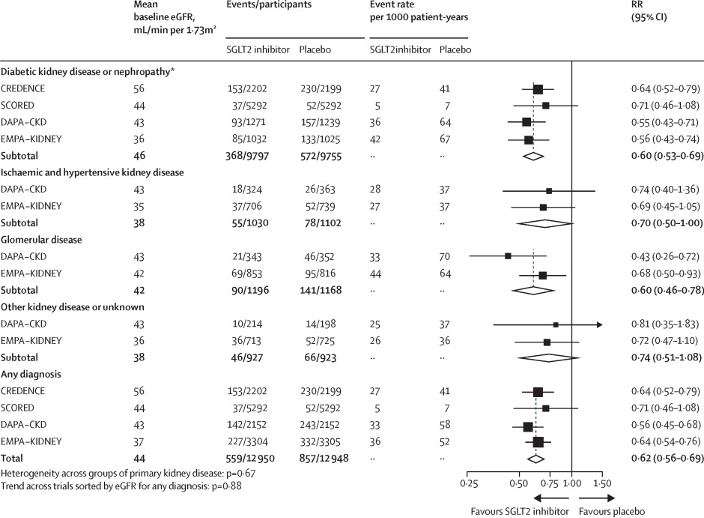
CI=confidence interval. eGFR=estimated glomerular filtration rate. RR=relative risk. SGLT2i=sodium glucose co-transporter-2 inhibitor.
Table 3.2: Effect of SGLT-2 inhibition on kidney disease progression, by type of glomerular disease (adapted from (3))
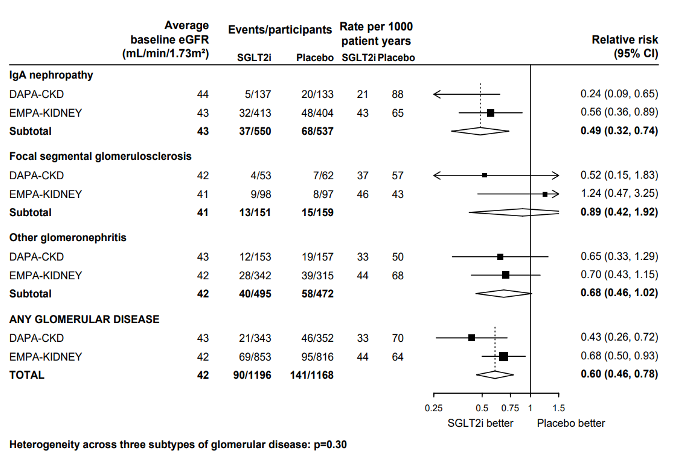
CI=confidence interval. eGFR=estimated glomerular filtration rate. RR=relative risk. SGLT2i=sodium glucose co-transporter-2 inhibitor.
Acute kidney injury in people without DM
SGLT-2 inhibitors have been shown not to increase the risk of acute kidney injury (AKI), as discussed in Section 2. The RSG and SMART-C collaborative meta-analysis assessed the effect of SGLT-2 inhibition on AKI stratified by diabetes status (3). SGLT-2 inhibition was found to reduce the risk of AKI overall by 23% (HR=0.77, 95%CI 0.70-0.84), and there was no evidence that the benefit in terms of AKI was different in people with or without diabetes (people without diabetes: HR=0.66, 95%CI 0.54-0.81; heterogeneity by diabetes status P=0.12), and was similar in the CKD and HF trial populations.
3.1.3 Summary of trial evidence on cardiovascular risk
Few participants without diabetes died from cardiovascular disease or were hospitalised for heart failure during follow up in the CKD trials. Among the 1398 DAPA-CKD participants without DM, 34 experienced a cardiovascular death or hospitalisation for heart failure event, while in EMPA-KIDNEY 69 participants experienced such an event. Consequently, the majority of evidence for the effect of SGLT-2 inhibitors on cardiovascular risk in people without diabetes comes from the heart failure trials, where the rate of cardiovascular death or hospitalisation for heart failure was approximately 5-10-fold that in DAPA-CKD or EMPA-KIDNEY (3).
Figure 3.3: Effect of SGLT-2 inhibition on cardiovascular death or hospitalisation for heart failure, by diabetes status (adapted from (3))
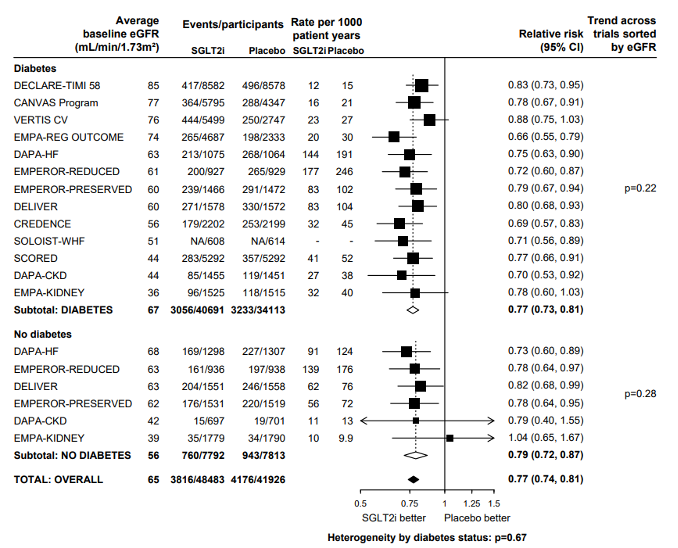
*Excludes urgent heart failure visits. EMPA-REG OUTCOME cardiovascular death definition excluded stroke. CI=confidence interval; eGFR=estimated glomerular filtration rate.
From the heart failure trials, DAPA-HF included people with an eGFR down to 30 mL/min/1.73m2, and 1926 (41%) of the trial population had an eGFR <60 mL/min/1.73m2. EMPEROR-REDUCED and EMPEROR- PRESERVED included people with an eGFR down to 20 mL/min/1.73m2, about one-half of both trials representing people with an eGFR <60 mL/min/1.73m2 (10-13). In DELIVER, which included participants to an eGFR of 25 mL/min/1.73m2, around 50% of participants had eGFR <60 mL/min/1.73m2, and 23% had an eGFR <45 mL/min/1.73m2 (2, 14). All four trials reported that SGLT-2 inhibition versus placebo reduced the risk of their primary composite outcomes based on cardiovascular death or hospitalisation for heart failure, with relative risk reductions appearing similar in size and nominally significant in people with and without DM (Figure 3.3) (2, 3, 10-15). Cardiovascular benefits were also unmodified among those with evidence of CKD (2, 3, 10-15).