
People without diabetes (Section 3)
- In the 2021 guideline, we recommended initiation of SGLT 2 inhibition in those without diabetes for people with stable symptomatic heart failure (irrespective of ejection fraction) with grade 1A level of evidence, and for people with uACR ≥25 mg/mmol with grade 1B level of evidence. In the present guideline update, we combine these recommendations into a single statement with grade 1A level of evidence.
Rationale: EMPA-KIDNEY provides evidence to confirm the findings from DAPA-CKD subgroup without diabetes (2, 4, 9).
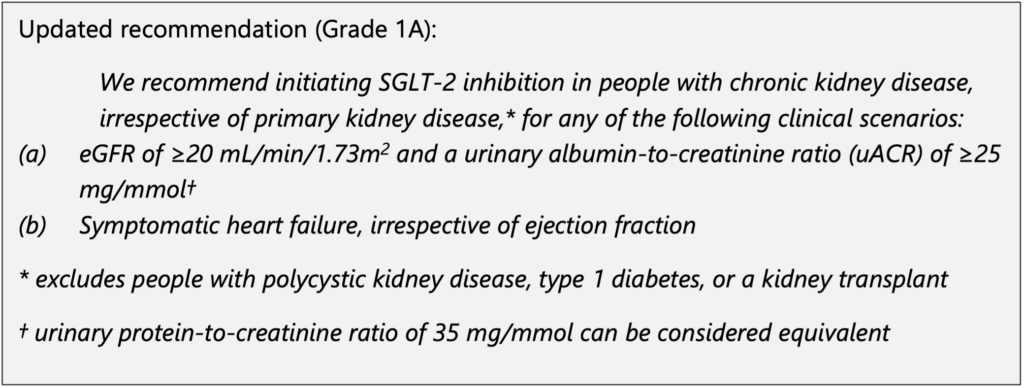
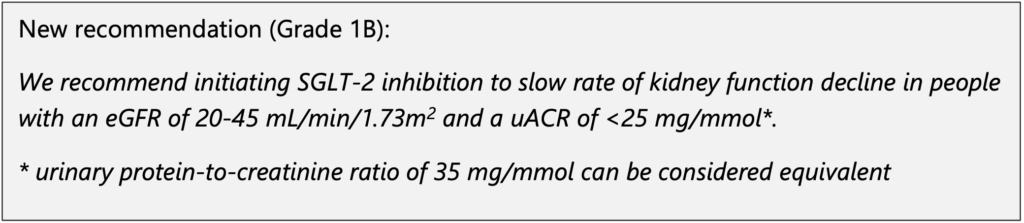
- We have added a new grade 1B recommendation to initiate SGLT 2 inhibition to slow rate of kidney function decline in people without diabetes with an eGFR of 20-45 mL/min/1.73m2 and a uACR <25 mg/mmol.
Rationale: Note that the guideline specifically refers to rate of decline of kidney function as opposed to kidney disease progression (which has a more specific definition in the trials). A grade 1 recommendation is made as the benefits clearly outweigh the risks. A grade 2 suggestion is a weaker recommendations and used when the risks and benefits are more closely balanced. The safety of SGLT 2 inhibition is well established in nearly 5000 people without diabetes from DAPA-CKD and EMPA-KIDNEY (the safety profile is better in people without diabetes than people with diabetes) (4). EMPA-KIDNEY demonstrated beneficial effects across the spectrum of eGFR in terms of progression of kidney disease in people with and without diabetes (2). Furthermore, EMPA-KIDNEY also showed that among people without albuminuria rate of kidney function decline (chronic eGFR slope) was reduced by 0.78 mL/min/1.73m2 per year in people with A1 levels of albuminuria (to a rate of 0.11 mL/min/1.73m2 per year), and by 1.20 mL/min/1.73m2 per year in people with A2 levels (see figure below). Such absolute benefits would be predicted to translate into clinically meaningful reduction in progression of kidney disease, even among people with low albuminuria at baseline (10). Among those with low levels of albuminuria and low eGFR at initiation, such effects on eGFR decline could translate into delay in the onset of kidney failure if used for several years. SGLT 2 inhibition also reduces risk of acute kidney injury in people with and without diabetes (4). This recommendation is purely based on evidence of efficacy. It does not take account of cost-effectiveness as these data are not yet available for this population.
Figure: Effects of empagliflozin versus placebo on the rate of eGFR decline in EMPA-KIDNEY, by key subgroups at baseline (adapted from (2))
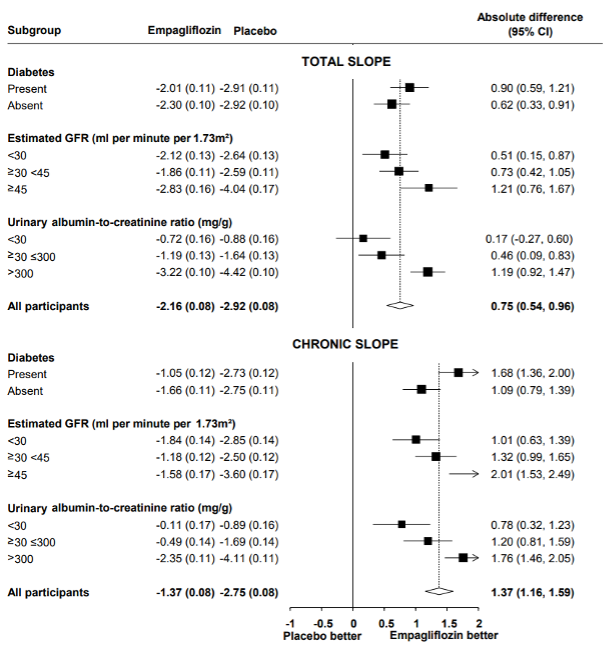 Mean annual rate of change in eGFR (mL/min/1.73m2/year) from baseline to final follow-up visit (“total slope”) and from two months to final follow-up visit (“chronic slope”).
- Consistent with the new recommendation for people with type 2 diabetes, we also suggest clinicians consider initiating SGLT 2 inhibition in people with eGFR less than 20 mL/min/1.73m2 to slow progression of kidney disease.
Rationale: See above.

People with or without diabetes
- In the present guideline update, we provide a simplified recommendation for screening for albuminuria that aligns the UKKA guidelines with those provided by NICE [NG203].

- We have strengthened and simplified the grade 2B recommendation from the 2021 guideline regarding continued use of SGLT 2 inhibition until the need for dialysis or kidney transplantation arises.
Rationale: Data from CKD trials include many hundreds of participants with an eGFR below 20 mL/min/1.73m2. Continued use of SGLT 2 inhibitors until the need for dialysis or kidney transplantation was the practice in these trials, which have confirmed benefits exceed any harms. In subgroup analyses, kidney benefits are unmodified by baseline eGFR. At a population level, people with a low eGFR are at highest absolute risk of kidney failure, and are therefore most likely to benefit (in absolute terms) (2, 4, 9).

- In view of the totality of evidence, which indicates beneficial effects of multiple different SGLT 2 inhibiting medications in the context of heart failure and progression of kidney disease, we now suggest that for both of these outcomes, the beneficial effects of SGLT 2 inhibition are likely to be class effects. We no longer state that there is insufficient data in people without diabetes to be conclusive.
Rationale: Meta-analysis of all large SGLT 2 inhibition trials indicates that there is consistency of the relative effects of SGLT 2 inhibition on risk of heart failure-based outcomes and kidney disease progression across all of the trials (4).

People with type 1 diabetes
- We have updated the 2021 recommendation stating the indications for referring people with type 1 diabetes to the specialist diabetes team for consideration of SGLT 2 inhibition in line with our updated recommendations for people with and without diabetes. Where we previously recommended referral for people with eGFR ≥25 mL/min/1.73m2 and uACR ≥25 mg/mmol attributable to diabetic nephropathy, we have now expanded this to include people with eGFR >20 mL/min/1.73m2, and removed the requirement for kidney disease to be attributable to diabetic nephropathy. We have increased the grade for this recommendation to 2C, given the available evidence from the InTandem3 trial (11).
Rationale: the updated thresholds reflect the evidence available from trials in SGLT 2 inhibition irrespective of the presence or absence of type 2 diabetes, including the evidence that benefits are not limited to diabetic nephropathy (4).

Acute decompensated heart failure
- In the present guideline update, we account for the increased availability of evidence in heart failure with preserved ejection fraction by incorporating recommendations for this population in sections 2 and 3. Consequently, section 7c pertains exclusively to people with acute decompensated heart failure. Since the previous iteration of this guideline, additional evidence has become available detailing the safety of SGLT 2 inhibition in acutely decompensated heart failure. Based on these data, we now suggest that SGLT 2 inhibition be considered in this population, with grade 2B level of evidence.
Rationale: The EMPULSE trial demonstrates that SGLT 2 inhibition safely increases the rate of clinical benefit for people hospitalised with acute heart failure, including participants with eGFR ≤30 mL/min/1.73m2 (based on favourable win ratio for a composite outcome) (12). Furthermore, EMPULSE and several small trials demonstrate safety with respect to adverse events and kidney function, as well as benefits in terms of clinical parameters including urine output and diuretic efficiency (13-17).
