
7b.1 Background
7b.1.1 Summary of trial evidence
Kidney transplantation offers advantages compared to other forms of kidney replacement therapy for many people with kidney failure, including people with diabetic nephropathy. These include potentially better quality of life and longer survival (11, 12). Currently, about 17% of incident UK kidney transplants are performed for diabetic nephropathy (13), and once transplanted new onset diabetes after transplantation (NODAT [also known as post-transplant DM]) is common. NODAT is important to identify as it predicts future mortality and graft failure (14). Its incidence has fallen over the last two decades and varies by diagnostic criteria and immunosuppressive protocol, but can still be as high as 10-20% during the first year after transplantation (15).
Sodium glucose co-transporter 2 (SGLT-2) inhibitors may have the potential to prevent and treat NODAT. From their mechanism of action, they may also provide cardioprotective and kidney benefits in people with a kidney transplant (see section 1 for details of SGLT-2 inhibitors’ mechanisms of action). However, kidney transplant recipients are also particularly susceptible to graft function loss with ascending urinary tract infections, and immunosuppression predisposes to genital mycotic infections. People on immunosuppression for kidney disease and those with kidney transplants have been excluded from the reported large placebo- controlled clinical outcome SGLT-2 inhibitor trials, including those specifically recruiting people with chronic kidney disease (CKD) (see Table 1.1 in section 1) (16-18).
A series of small observational studies have reported experience of prescribing SGLT-2 inhibitors to kidney transplant recipients (19, 20), but our literature review identified a single randomised trial by Halden and colleagues (21). This single-centre 24-week placebo-controlled trial was conducted in a population of people with NODAT who were at least one year since transplantation with stable graft function. Below we provide a summary of this single trial and offer a summary statement.
Effects of SGLT-2 inhibition on hyperglycaemia, weight, blood pressure, kidney function, and adverse events in NODAT from Halden et al. (21).
Halden et al. analysed 44 participants with NODAT randomised 1:1 to empagliflozin 10mg versus matching placebo. Mean baseline kidney function was just over 60 mL/min/1.73m2 and median glycosylated haemoglobin (HbA1c) was ~6.9% (~52 mmol/mol). At 24 weeks, median change in HbA1c from baseline was – 0.2% (-2.0 mmol/mol) among those allocated empagliflozin versus +0.1% (+1.0 mmol/mol) among those allocated placebo (difference in change between arms p=0.025: Table 7b.1). There were no significant differences in other glycaemic or insulin parameters, including fasting or 2-hour blood glucose, insulin or c- peptide concentrations (Table 7b.1) (21). The effect on HbA1c varied by baseline estimated glomerular filtration rate (eGFR), with the expected pattern of larger HbA1c reductions among those with an eGFR ≥60 mL/min/1.73m2, and almost no difference in HbA1c among those with an eGFR of 40-50 mL/min/1.73m2 (people with an eGFR <30 mL/min/1.73m2 were excluded). This attenuated effect on HbA1c corresponded to a linear decrease in glucose excretion with lower eGFR.
Table 7b.1: Effects of empagliflozin 10mg versus placebo on glycaemia, weight, blood pressure and kidney function in kidney transplant recipient with new onset diabetes after transplantation from Halden et al. (21)
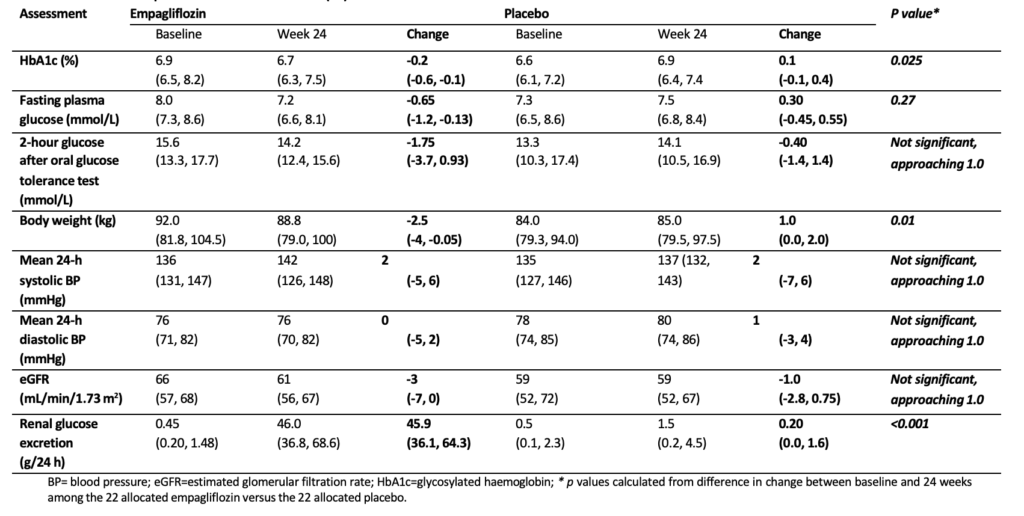
At 24 weeks, there was evidence that empagliflozin reduced weight, but there was no difference in blood pressure between the study arms (Table 7b.1). Blood levels of calcineurin inhibitors and everolimus were also not significantly different between the empagliflozin and placebo arms (21). At 8 weeks of follow-up, eGFR acutely declined by an average of -4mL/min/1.73m2 among those allocated empagliflozin versus -1 mL/min/1.73m2 among those allocated to placebo. By 24 weeks, this difference had reduced to -3 versus -1 mL/min/1.73m2 (Table 7b.1).
Empagliflozin was generally well tolerated. One participant allocated empagliflozin withdrew from the trial due to urosepsis. There were three urinary tract infections in each arm, and no reported episodes of rejection (21).
7b.1.2 Quality of the evidence
Currently, the reported randomised evidence of the effects of SGLT-2 inhibitors in kidney transplant recipients is limited to less than 50 trial participants with NODAT followed for less than 6 months from a single centre. There is therefore currently insufficient data to provide specific evidence-based recommendations for safe use of SGLT-2 inhibition in this population (22). There are a number of older anti- diabetic treatments with well-known safety profiles which can be used to treat hyperglycaemia in NODAT. This section of this guideline will be updated as more randomised evidence becomes available.
7b.2 Summary Statements
- There is currently insufficient evidence on safety and efficacy to provide recommendations for use of SGLT-2 inhibition in people with a functioning kidney transplant.
- Any use of SGLT-2 inhibition to treat diabetes mellitus in a kidney transplant recipient should be evaluated by multi-disciplinary discussion (Grade 2D)
Note: effects on glycaemic control at an eGFR <60 mL/min/1.73m2 in people with a kidney transplant appear small and potential risk of complications from urinary tract infection should be considered.
7b.3 Clinical Research Recommendations
The generation of reliable randomized trial evidence for transplant recipients is a key research recommendation. Please refer to section 2.3.