
Guideline 2.1 Augmented schedules
We suggest offering an augmented schedule to patients who are unable to achieve adequacy targets or fluid control on a standard thrice weekly schedule. [2B]
We suggest that relative contraindications to augmented schedules should be considered, such as significant residual function or problematic fistula access. [2C]
Rationale
Dialysis dose on a thrice weekly schedule is limited by patient tolerance and the necessity to utilise ‘slots’ efficiently, so that sessions over 5 hours are very uncommon. ‘Augmented’ in this guideline refers to increased frequency (4 6 sessions per week) or thrice weekly dialysis totalling more than 15 hours per week. The latter is usually delivered nocturnally when in centre, but both are often delivered in the context of home haemodialysis where much of the evidence regarding augmented dialysis schedules has been obtained.
Augmented schedules have been assessed in four randomised studies [1 4], one interventional study with matched controls [5], and a handful of observational studies. Evidence of clinical benefit limited to interventional studies is summarised below, with studies divided into three groups for ease of discussion, according to the type of augmented schedule [1 6]. A fourth group of augmented schedules which might be termed ‘modestly frequent’ (4 or 5 sessions per week, of up to 4 hours each) is poorly represented in studies.
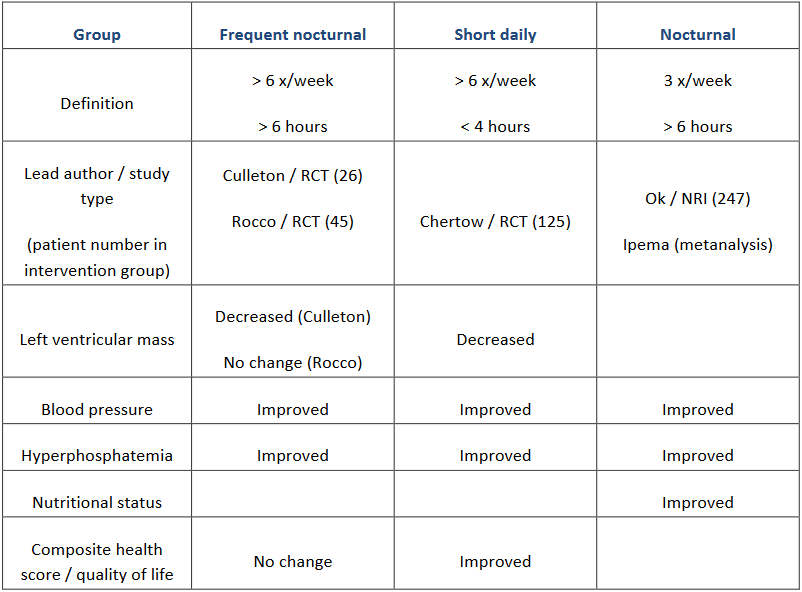
Abbreviations: RCT randomized controlled trial, NRI non randomised intervention
Where assessed, improvements in depression, cognition or anaemia parameters were generally not seen in these studies, although improvements in these aspects have been reported in a number of observational studies.
Quality of life is an important outcome since the intervention clearly involves increased treatment burden. Observational studies suggest that quality of life of life is improved in daily dialysis by approximately 6%, whereas nocturnal schedules have not been show to improve quality of life [7 9].
The randomised studies were not designed primarily to assess mortality within the study period, but two of these published mortality results with follow up extended by approximately 2.5 years [10,11], and mortality effects have also been reported in other types of study. Findings have been surprisingly inconsistent, however, and are summarised in the table below [5,10 14].
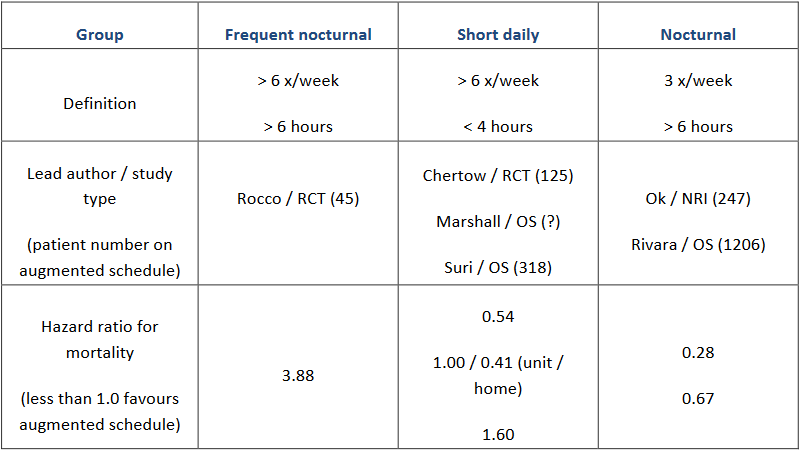
Abbreviations: RCT randomized controlled trial, NRI non randomised intervention, OS observational study
Authors stress that clinical trials of more intensive dialysis were not designed to evaluate mortality, and that observational analyses often employ statistical techniques which do not adequately address the time varying nature of the risk factors associated with both the initiation of augmented dialysis and mortality.
The larger randomised trials of augmented schedules have also identified potential harms, for example reducing residual function, an important determinant of survival on haemodialysis. In patients who had significant residual function at enrolment, both frequent nocturnal and short daily dialysis led to a more rapid decline in function compared to control groups [15]. Intervention patients had a shorter time to first vascular access intervention, and there were small increases in the burden on carers, as perceived by patients, though the authors highlight that carers themselves were not assessed [16].
Taken together these studies suggest equivalent mortality and modest improvement in some dialysis related conditions, offset by increased treatment burden and possible harms to vascular access and residual function. Whilst there is no overall advantage for the average patient these studies do suggest specific groups who would be expected to benefit. For example, adequacy targets could certainly be achieved in those still unable to, despite a reasonably long thrice weekly schedule. Similarly, patients failing to achieve fluid control are likely to benefit from an increase in dialysis frequency this might include those with resistant hypertension, intra dialytic hypotension, and those with weekend admissions to hospital. The latter group are the obvious contributors to the excess mortality of the two day dialysis gap, and may have the most to gain from an increase in dialysis frequency. The augmentation of dialysis in these settings should be aimed at achieving a specific purpose, and it is likely that a fourth session per week would be sufficient in many cases.
In conclusion, augmented schedules offer no clear advantage for the majority of patients, but should be considered as a treatment option for those patients whose adequacy or fluid control targets are not met with a standard schedule. A modestly augmented schedule would be sufficient in the majority of these patients.
References
1. Culleton, B.F., et al., Effect of frequent nocturnal haemodialysis vs conventional haemodialysis on left ventricular mass and quality of life: a randomized controlled trial. JAMA, 2007. 298(11): p. 1291 9.
2. Rocco, M.V., et al., The effects of frequent nocturnal home haemodialysis: the Frequent Haemodialysis Network Nocturnal Trial. Kidney Int, 2011. 80(10): p. 1080 91.
3. Chertow, G.M., et al., In center haemodialysis six times per week versus three times per week. N Engl J Med, 2010. 363(24): p. 2287 300.
4. McGregor, D.O., et al., A Comparative Study of Blood Pressure Control with Short In Center versus Long Home Haemodialysis. Blood Purification, 2001. 19(3): p. 293 300.
5. Ok, E., et al., Comparison of 4 and 8 h dialysis sessions in thrice weekly in centre haemodialysis: a prospective, case controlled study. Nephrol Dial Transplant, 2011. 26(4): p. 1287 96.
6. Ipema, K.J. et al., Nutritional Status in Nocturnal Haemodialysis Patients A Systematic Review with Meta Analysis. PLoS One. 2016 Jun 20;11(6):e0157621
7. Wang, W., et al., The Effect of Increasing Dialysis Dose in Overweight Haemodialysis Patients on Quality of Life: A 6 Week Randomized Crossover Trial. American Journal of Kidney Diseases, 2008. 51(5): p. 796 803.
8. Garg, A.X., et al., Patients receiving frequent haemodialysis have better health related quality of life compared to patients receiving conventional haemodialysis. Kidney Int, 2017. 91(3): p. 746 754.
9. Jardine, M.J., et al., A Trial of Extending Haemodialysis Hours and Quality of Life. Journal of the American Society of Nephrology, 2017. 28(6): p. 1898 1911.
10. Rocco, M.V., et al., Long term Effects of Frequent Nocturnal Haemodialysis on Mortality: The Frequent Haemodialysis Network (FHN) Nocturnal Trial. Am J Kidney Dis, 2015.
11. Chertow, G.M., et al., Long Term Effects of Frequent In Center Haemodialysis. J Am Soc Nephrol, 2015. 66(3): 459–468.
12. Marshall, M.R., et al., Intensive Haemodialysis and Mortality Risk in Australian and New Zealand Populations. Am J Kidney Dis, 2016. 67(4): p. 617 28.
13. Suri, R.S., et al., A multinational cohort study of in center daily haemodialysis and patient survival. Kidney Int, 2013. 83(2): p. 300 7.
14. Rivara, M.B., et al., Extended hours haemodialysis is associated with lower mortality risk in patients with end stage renal disease. Kidney International, 2016. 90(6): p. 1312 1320.
15. Daugirdas, J.T., et al., Effect of frequent haemodialysis on residual kidney function. Kidney Int, 2013. 83(5): p. 949 58.
16. Suri, R.S., et al., Effects of frequent haemodialysis on perceived caregiver burden in the Frequent Haemodialysis Network trials. Clin J Am Soc Nephrol, 2014. 9(5): p. 936 42.
Guideline 2.2 Incremental schedules
We suggest that lower haemodialysis dose targets may be optimal in patients with significant residual renal function. [2D]
We recommend that residual renal function should be quantified intermittently in patients on incremental dialysis schedules. [1D]
Rationale
Incremental haemodialysis is based on the common sense concept that the amount of dialysis required for optimal outcome differs between those with significant residual function and those without. The latter group however is larger, and makes up the majority in studies of dose and outcome, which therefore may not be applicable in the former group. Optimal dialysis dose is therefore not fixed but dependent on the level of residual kidney function, and the prescribed schedule may therefore be reduced in frequency or dose in this setting. The practice of incremental haemodialysis is consistent with a concept of progressively increasing therapy over time, which may include augmented schedules at a later stage (figure 1).

Figure 1. Schematic to illustrate principle of incremental haemodialysis (numbers only as examples)
Less frequent and reduced dose dialysis practices co evolved along with standard thrice weekly schedules: reference is made to twice weekly dialysis in observational studies from the 1990s and in the 1997 KDOQI guidelines [1]. For example, in an observational study of 15 000 American patients published in 1999, Hanson reported twice weekly schedules in 6.1% of patients during their first year, and 2.7% of patients thereafter [2]. Outcomes were at least as good, and in fact a mortality advantage was observed with twice weekly schedules, most likely due to differences in baseline factors: no mortality difference was seen after adjustment for the level of residual function at dialysis initiation.
The non inferiority of twice weekly schedules in selected patients has been further supported by more recent studies. In a Thai study of 500 twice weekly patients Panaput reported equivalent mortality and hospitalisation over the next year [3], and in a propensity matched Korean study of 300 patients followed for one year, Park reported equivalent mortality and improved quality of life with schedules less than thrice weekly [4]. Non inferiority of clinical outcome with reduced treatment burden therefore provides a powerful argument in favour of incremental schedules, but additional benefits may exist: incremental haemodialysis schedules have also been associated in some observational studies with reduced decline in residual kidney function [5,6].
Preservation of residual function is of clinical importance since it provides significant solute and fluid removal, and is associated with improved quality of life and survival [7].
The literature on incremental schedules is limited in particular by its observational nature, with inherent problems of selection and lead time bias. Variation also exists in the definition of incremental dialysis, which is frequently defined as twice weekly, without reference to residual function. Clinician bias may also be important: clinicians working in the 1990s will remember twice weekly schedules principally as a resource sparing exercise, and even in modern series, financially constraints play a part in their use [8].
Patient selection is therefore crucial: factors currently associated with reduced schedule use in a large Chinese study include early vintage, female sex and minimal comorbidity [9]. And the level of residual function appears perhaps unsurprisingly to be the most important factor: in a large American study in which 350 twice weekly patients were matched with a thrice weekly group, twice weekly schedules yielded equivalent one year outcome in many, but were clearly inferior in those with the poorest residual function (clearance less than 3ml/min/1.73m2) [10]. Those with residual clearance of 3ml/min or less may still be suitable for a thrice weekly incremental schedule (i.e. with dose target less than Kt/V 1.2 and/or less than 4 hours).
The use of incremental haemodialysis therefore requires regular monitoring of residual function, with function reassessed after major intercurrent illness [11]. Suitable patients should be aware that dialysis duration is likely to increase over time, and should be willing to cooperate with residual function measurements [12].
Incremental dialysis is entirely consistent with the concepts of adequate dialysis dose established in the NCDS and HEMO studies as discussed in section 1, but incorporates the contribution of residual function, so that dialysis and residual function are seen as both contributing to overall clearance. There are a number of different methods for quantifying combined kidney and dialysis urea clearance (summarised in Appendix B) which can help with schedule and dose selection. These should be interpreted in clinical context, with due observation of indirect measures of dialysis adequacy such as control of symptoms, blood pressure, fluid gains and electrolytes, so that dialysis dose can be appropriately escalated if treatment appears clinically inadequate.
References
1. NKF DOQI clinical practice guidelines for haemodialysis adequacy. National Kidney Foundation. Am J Kidney Dis. 1997 Sep;30(3 Suppl 2):S15 66.
2. Hanson JA, Hulbert Shearon TE, Ojo AO, Port FK, Wolfe RA, Agodoa LY, et al. Prescription of twice weekly haemodialysis in the USA. Am J Nephrol. 1999 Jan;19(6):625–33.
3. Panaput T, Thinkhamrop B, Domrongkitchaiporn S, Sirivongs D, Praderm L, Anukulanantachai J, et al. Dialysis Dose and Risk Factors for Death Among ESRD Patients Treated with Twice Weekly Haemodialysis: A Prospective Cohort Study. Blood Purif. 2014;38(3–4):253–62.
4. Park JI, Park JT, Kim Y L, Kang S W, Yang CW, Kim N H, et al. Comparison of outcomes between the incremental and thrice weekly initiation of haemodialysis: a propensity matched study of a prospective cohort in Korea. Nephrol Dial Transplant. 2016 Sep 28;
5. Lin Y F, Huang J W, Wu M S, Chu T S, Lin S L, Chen Y M, et al. Comparison of residual renal function in patients undergoing twice weekly versus three times weekly haemodialysis. Nephrology (Carlton). 2009 Feb;14(1):59–64.
6. Zhang M, Wang M, Li H, Yu P, Yuan L, Hao C, et al. Association of initial twice weekly haemodialysis treatment with preservation of residual kidney function in ESRD patients. Am J Nephrol. 2014 Jan;40(2):140–50.
7. Vilar E, Wellsted D, Chandna SM, Greenwood RN, Farrington K. Residual renal function improves outcome in incremental haemodialysis despite reduced dialysis dose. Nephrol Dial Transplant. 2009 Aug;24(8):2502–10.
8. Lin X, Yan Y, Ni Z, Gu L, Zhu M, Dai H, et al. Clinical outcome of twice weekly haemodialysis patients in shanghai. Blood Purif. 2012 Jan;33(1–3):66–72.
9. Bieber B, Qian J, Anand S, Yan Y, Chen N, Wang M, et al. Two times weekly haemodialysis in China: frequency, associated patient and treatment characteristics and Quality of Life in the China Dialysis Outcomes and Practice Patterns study. Nephrol Dial Transplant. 2014 Sep;29(9):1770–7.
10. Obi Y, Streja E, Rhee CM, Ravel V, Amin AN, Cupisti A, et al. Incremental Haemodialysis, Residual Kidney Function, and Mortality Risk in Incident Dialysis Patients: A Cohort Study. Am J Kidney Dis. 2016 Aug;68(2):256–65.
11. Lucas MF, Teruel JL, Ruíz Roso G, Díaz M, Raoch V, Caravaca F, et al. Incremental Haemodialysis Schedule in Patients with Higher Residual Renal Function at the Start of Dialysis. Adv Nephrol. Hindawi Publishing Corporation; 2014;1–6.
12. Fernández Lucas M, Teruel Briones JL, Gomis Couto A, Villacorta Pérez J, Quereda Rodríguez Navarro C. Maintaining residual renal function in patients on haemodialysis: 5 year experience using a progressively increasing dialysis regimen. Nefrologia. 2012 Jan;32(6):767–76.
Guideline 2.3 Conservative schedules
We suggest that lower haemodialysis dose targets may be optimal when quality of life is the primary goal of treatment, rather than longevity. [2D]
Rationale
Whilst concepts of dialysis dose have been developed over the last two decades, the dialysis population has been changing, with the median age of the prevalent dialysis population increasing by nearly 20 years, and diabetes becoming one of the leading causes of established kidney failure. For many patients, dialysis is a long term maintenance therapy that continues until death or dialysis withdrawal, with increasing comorbidity and frailty developing during this time [1].
This changing demographic has important implications for the clinical application of dialysis dose. Firstly, studies have typically focused on younger patients (median age 49 in the NCDS study including no diabetics, and mean age 58 in the HEMO study) so that applying their conclusions in a more elderly group is an extrapolation. Secondly, studies are generally more concerned with mortality, and many strategies in dialysis are aimed at preventing future complications, whereas current symptoms and quality of life are often more relevant to the frailer patient. And thirdly, the burden of dialysis often increases with increasing frailty, so that there is a greater trade off when considering the burden versus the benefit of treatment. In the context of this changing demography, it is reasonable to question whether conventional dialysis dosing and targets remain appropriate for this population [2].
Frailty as a clinical syndrome can be defined when a number of factors are present including: unintentional weight loss, self reported exhaustion, weakness and low physical activity. The presence of frailty is associated with increasing disability and hospitalisation, and in dialysis patients, with an adverse quality of life irrespective of dialysis modality.
The optimum dialysis for frail patients has only been studied in small cohorts. Some overlap exists between the features of frailty and those of underdialysis, and it could be argued that more intensive dialysis might better control some aspects such as fluid overload, intradialytic hypotension or sarcopenia, or conversely that nutritional decline might be accelerated by reduced dialysis. Reductions in dialysis quantity should therefore not be misunderstood as a method of improving these aspects of frailty. However, while increasing hours or frequency of dialysis may theoretically overcome some of these problems, patients often perceive the burden of dialysis on their quality of life more than the symptomatic benefit, and dialysis itself may confer specific harms in this group: a retrospective study identified frequent functional deterioration among dependent patients following the initiation of dialysis [3].
In a challenging clinical area with a paucity of outcome data, it therefore seems entirely appropriate to reduce or disregard numeric targets for dialysis dose, instead individualising dialysis according to specific patient goals. Goal oriented care is an established approach in patients with multiple co morbidities which overcomes the problems inherent in disease specific care processes, with discussions instead concentrating on a patient’s individual aims of treatment.
Shared discussions about dialysis schedule, driven by patient centred goals can ensure that patients are neither under or over treated, and in some cases might be a precursor to dialysis withdrawal. Such discussions may need frequent review following changes in the patient’s clinical or personal circumstances.
References
1. Vandecasteele SJ, Kurella TM. A patient-centered vision of care for ESRD: dialysis as a bridging treatment or as a final destination? J Am Soc Nephrol. 2014;25(8):1647–1651.
2. Tattersall J, Farrington K, Gentile G, et al. Is Kt/V useful in elderly dialysis patients? Pro and Con arguments. Nephrol Dial Transplant. 2018:33(5):742 750.
3. Kurella Tamura M, Covinsky KE, Chertow GM, Yaffe K, Landefeld CS, McCulloch CE. Functional status of elderly adults before and after initiation of dialysis. N Engl J Med. 2009;361(16):1539–1547.
Guideline 2.4 Paediatric schedules
In children and adolescents we recommend an approach to the assessment of dialysis adequacy which goes beyond biochemical targets, incorporating clinical goals such as growth, bone health, cardiac function and quality of life. [1C]
We recommend targeting dialysis dose to achieve a minimum eKt/V of 1.2 for thrice weekly patients, or a standardized Kt/V of 2.2 for those on augmented schedules. [1C]
We suggest an augmented schedule for children on predominantly liquid nutrition, and those with ventricular systolic dysfunction. [2D]
We recommend a blood flow rate of 5 7ml/kg/min for the majority of patients, using consumables appropriate to body size, with extracorporeal volume less than 10% of the patient’s blood volume. [1C]
Rationale
The low incidence of dialysis requiring kidney disease in childhood, means that many treatment decisions are informed by observational data and studies carried out in adults. The small solute dose target for adults (eKt/V over 1.2) therefore has some relevance to children, though cautious interpretation of a target extrapolated from a different clinical setting would lead many clinicians to aim for a more conservative (i.e. higher) target dose. In addition, unique physiological aspects of childhood, such as growth, may be improved by increased dialysis dose, and there are strong arguments to suggest that optimum Kt/V may be size dependent in adults, so that a higher minimum Kt/V may be appropriate [1]. The desirable lower limit for eKt/V is therefore thought to be between 1.2 and 1.4.
However, as is increasingly recognized now in adults, it has long been argued that the optimal quantity of dialysis for children cannot be characterized by a single numerical measurement [2]. In addition to the desirable clinical outcomes shared with adults, the therapeutic goals for children and adolescents receiving dialysis include achievement of normal growth, bone maturation and social development, along with avoidance of cardiac compromise and disrupted education. The increasing evidence that dialysis dose and schedule is able to improve cardiac function and outcomes in many of these domains argues for a broader concept of “adequacy” which might best be assessed using a constellation of clinical outcomes, as well as biochemical targets.
Augmented dialysis, with increased frequency in particular, is therefore increasingly advised by clinicians, and despite the obvious drawback of treatment burden, does not seem to reduce quality of life, even in adolescents [3]. It is possible that augmented schedules are optimal for all children, but some groups seem particularly likely to benefit, including those with cardiac dysfunction and those on a liquid diet, in whom it might otherwise be difficult to achieve safe fluid control [4].
Safe limits appropriate to body size are advocated for many aspects of the extracorporeal circuit, such as a blood flow rate of 5 7ml/min/kg, which is often adequate to achieve dialysis dose with double needles, with arterial aspiration pressures below 200mmHg, to limit endothelial trauma. For single needle dialysis the highest blood flow rate is obtained using a double pump system (venous flow higher than arterial) monitored by pressure (time pressure regulation), with clamp techniques used to achieve an acceptable compromise between recirculation and blood flow [5]. Consumables appropriate to body size should be selected so that total extracorporeal volume is less than 10% of blood volume, to reduce the volume load with wash back at the end of the session. System priming with albumin or even blood may sometimes be required for babies and small infants.
References
1. Sharma A (2001) Reassessing haemodialysis adequacy in children: the case for more. Pediatr Nephrol 16:283–290.
2. Goldstein SL (2004) Adequacy of dialysis in children: does small solute clearance really matter? Pediatr Nephrol 19:1–5.
3. Bell L, Espinosa P (2003) Intensive in center haemodialysis for children: a case for longer dialysis duration. Hemodial Int 7(4):290–295.
4. Fischbach M, Terzic J, Laugel V, Dheu C, Menouer S, Helms P, Livolsi A (2004) Daily on line hemodiafiltration: a pilot experience in children. Nephrol Dial Transplant 19:2360–2367.
5. Coulthard MG, Sharp J (2001) Haemodialysis in infants: theoretical limitations, and singles versus double lumen lines. Pediatr Nephrol 16:332–334.
Guideline 2.5 Schedules during pregnancy
We recommend counselling women of reproductive age who are receiving or anticipating dialysis, so that they are aware of the interactions between renal replacement therapies and pregnancy which may impact on family planning and modality decisions. [1D]
For dialysis patients wishing to continue their pregnancy, we recommend changing as early as possible to an individualised, augmented haemodialysis schedule. For those with minimal residual function this should be at least 20 hours per week, delivered over at least 6 sessions. [1B]
We recommend an individualised dialysate prescription appropriate to the dialysis schedule and biochemistry results, anticipating the frequent need for a high potassium / low bicarbonate dialysate, supplemented with phosphate. [1C]
We suggest an individualised fluid management protocol, with low ultrafiltration rates and regular clinical assessment, anticipating the typical change in weight during pregnancy. [2C]
Rationale
Successful pregnancies in women on haemodialysis are becoming more common: prior to 1995 data from the USA suggested only 40% infant survival, but outcomes in the current era are substantially better [1]. However, pregnancy complications in haemodialysis patients are still more common than in pre dialysis and transplant patients, and may result in HLA sensitisation, so delaying until after transplantation may be favourable for some. Conception may be more likely with augmented dialysis schedules [2], but the possibility of pregnancy or need for contraception should be considered regardless of dialysis schedule.
The literature linking haemodialysis prescription to outcome in pregnant dialysis patients is limited to case series and systematic reviews [3]. In a recent meta analysis of 681 pregnancies in 647 patients between 2000 and 2014, authors found that longer weekly dialysis duration significantly associated with a lower incidence of preterm delivery and babies small for their gestational age [4]. More frequent dialysis was also associated with fewer small babies. Normalisation of biochemistry and fluid status appears to give the best outcome, and virtually every publication advocates intensified dialysis.
The best evidence for this approach to date is the comparison of data from the Toronto and US registries of pregnancy in dialysis patients [5]. In women established on dialysis before becoming pregnant, 11 of 13 pregnancies were successful with at least 36 hours per week, compared to 22 of 46 with up to 20 hours (p=0.02). More intensive dialysis was also associated with reduced preterm delivery and greater birth weight.
Residual kidney function facilitates normalisation of fluid and electrolytes, so the accelerated loss of residual function seen with augmented schedules raises concerns about this approach in women with good urine output [6]. In the Toronto/US registry study all of the 17 women who started dialysis partway through the pregnancy had a successful outcome. Since 13 of them were in the shorter treatment group, it appears that longer treatment times would have been unnecessarily burdensome, and possibly detrimental, to patients with significant residual function. In a comprehensive review Hladunewich suggested titrating the dialysis dose to achieve urea 10 15mmol/L after the longest break between sessions [7]. The authors also provide advice on adjusting medication, anaemia management and fetal monitoring which are outside the scope of this guideline.
With augmented schedules dialysate should be individualised, with high potassium / low buffer often required. To ensure the needs of foetal skeletal development are met, low serum calcium and phosphate should be avoided, which may involve adjustment of diet, medication and dialysate: supplementation of the dialysate with phosphate is often necessary. Magnesium should possibly be monitored in the third trimester, since low levels may induce uterine contraction.
Augmented schedules allow patients with minimal residual kidney function to remain close to their target weight and avoid high ultrafiltration rates. Fluid status needs to be assessed frequently during pregnancy, as there is a high risk of fluid depletion, especially in the second and third trimester, and bioimpedance and urine volume may be useful measurements in this setting. Typical weight gains during a healthy pregnancy range from 10 15kg, and weight gain below this range is usually associated with worse fetal outcome. The higher baseline weight of many women on dialysis can complicate interpretation, but serial weight tracking remains useful as a surrogate measure of fetal growth and fluid balance.
References
1. Hou S. Pregnancy in women on haemodialysis and peritoneal dialysis. Baillieres Clin Obstet Gynaecol. 1994 Mar;8(1):131 46.
2. Okundaye I, Abrinko P, Hou S. Registry of pregnancy in dialysis patients. Am J Kidney Dis. 1998 Dec;31(6):766 73.
3. Piccoli GB, Cabiddu G, Attini R, Parisi S, Fassio F, Loi V, et al. Outcomes of pregnancies in dialysis patients: a systematic review and meta analysis of the last two decades. Clin J Am Soc Nephrol. 2014 Jun 6;9(3):1154 63.
4. Hladunewich MA, Hercz A, Keunen J, Chan CT, Pierratos A. Pregnancy in end stage renal disease. Semin Dial. 2017; 31(2):151 161.
5. Piccoli GB, Minelli F, Versino E, Rolfo A, Lespade M, Burdese M, et al. Pregnancy in dialysis patients in the new millennium: A systematic review and meta regression analysis correlating dialysis schedules and pregnancy outcomes. Nephrol Dial Transplant. 2016 Apr;31(4):515 23.
6. Chang HH, Chauhan SP, Blankson ML, Hopkins D, McIntire DD, Leveno KJ. Fetal weight gain and length of hospital stay in pregnancies complicated by end stage renal disease on haemodialysis. Am J Obstet Gynecol. 1996 Jul;175(1):2 6.
7. Hladunewich M. Pregnancy in women on dialysis: lessons from the Toronto Pregnancy and Kidney Disease Research Program. Int J Am Soc Nephrol. 2018 Mar;6(2):10 12.