
3. Membrane flux and haemodiafiltration
We recommend that patients with minimal residual function should be treated with high flux dialysers. [1B]
We suggest that haemodiafiltration may be considered as a treatment for intra dialytic hypotension refractory to other measures, and for dialysis patients with favourable prognosis who are unable or unlikely to be transplanted. [2B]
Rationale
Convective clearance
Haemodialysis removes uraemic toxins by two very different physical processes: diffusion and convection.
Diffusion is the movement of solutes independent of solvent when the concentration differs between the two sides of a membrane. The rate is dependent on the concentration difference, the diffusion coefficient of the membrane, as well as the blood and dialysate flows, and this process is extremely efficient for small solutes, such as urea. Convection is the movement of those solutes not excluded by pore size, along with their solvent as it crosses the membrane. The rate depends on molecular size and the ultrafiltration rate, and this process is most important for molecules too large for efficient diffusion, but still smaller than the membrane pores, often termed ‘middle molecules’ [1].
Convective clearance is therefore a measurable component of dialysis, which is qualitatively and quantitatively distinct from urea clearance and treatment time. Diffusion of a solute is usually quantified by its Kt/V (Appendix A) whereas convection is best quantified by its sieving coefficient and the ultrafiltration rate (Appendix C).
Ascending quantities of convection are therefore achieved with low flux dialysis, high flux dialysis, and haemodiafiltration. Historically low flux dialysis was standard, in part because it requires less accurate ultrafiltration control from the dialysis machine ultrafiltration in standard low flux dialysis is simply equal to the fluid removed from the patient, usually around 2 litres. In high flux dialysis pore size is increased, increasing the sieving coefficient for middle molecules, but also the permeability to water is improved, so that internal filtration (bidirectional movement of water within the dialyser) becomes significant: net ultrafiltration of course remains the same, but total ultrafiltration, all of which contributes to middle molecule clearance, is greater and may be as much as 10 litres. In haemodiafiltration a large volume of replacement fluid is given, to allow net ultrafiltration to be increased to around 20 litres (Appendix C). There is little difference in clearance of small solutes between these methods [3].
Of the (over 100) uraemic toxins known, many are middle molecules (with molecular weight in the range 0.6 60kDa) for which clearance is largely dependent therefore on convection. Convective quantity does not improve clearance of all poorly diffusing molecules, with phosphate clearance for example, largely unaffected, but clearance of many, such as β 2 microglobulin, is progressively increased by high flux dialysis and haemodiafiltration. A contribution of convective dialysis quantity to favourable outcome is strongly suspected.
Membrane flux
Several interventional studies give insight into the impact of membrane flux on dialysis outcomes, for example in the other part of its 2×2 design, the HEMO study group compared high flux with low flux dialysis. In the whole group (N=1846) high flux dialysis did not confer a clear survival advantage (RR 0.92, 95%CI 0.81 1.04) although cardiac mortality was reduced (RR 0.80, 95%CI 0.65 0.99). In the roughly one third (N=577) of patients with over 3.7 years dialysis vintage prior to randomisation, high flux dialysis improved survival substantially (RR 0.68, 95%CI 0.53 0.86).
The Membrane Permeability Outcome study randomised 738 incident patients to high vs low flux dialysis, stratified by serum albumin (normal vs subnormal). Over a mean observation of 3 years, high flux dialysis reduced mortality in the low albumin group (N=493, HR 0.63, 95%CI 0.45 0.90) with a less clear reduction in mortality in the whole group. High flux was similarly advantageous in the subgroup with diabetes.
A meta analysis of 33 studies comparing high flux with low flux dialysis in 3820 patients, found reduced cardiovascular mortality (RR 0.83, 95%CI 0.70 0.99) and a less clear reduction in all cause mortality (RR 0.95, 96%CI 0.87 1.04). Endotoxin tends to be absorbed within high flux membranes, rather than passing through, and initial concerns that dialysate endotoxin would be more problematic with high flux dialysis appear to have been unfounded.
Whilst no study has unequivocally demonstrated the superiority of high flux dialysis for survival, there is clear evidence of improved cardiovascular outcomes, and all cause mortality appears to be improved in several subgroups. At the same time, evidence of harm is lacking, all modern machines have accurate ultrafiltration control, and membrane costs are now equivalent. Further research on this question therefore does not seem to be a high priority.
Haemodiafiltration
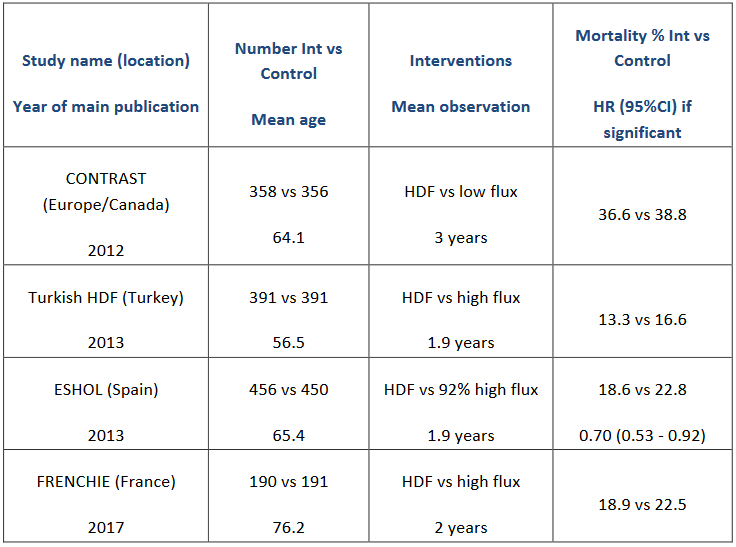
The effect of haemodiafiltration has been informed by four randomised controlled studies. In three of these, marginal but non significant advantages were seen in the haemodiafiltration group, with subgroup analysis suggesting favourable outcome with the highest convection volumes, though the latter to some extent may reflect body size or treatment tolerance.
A clear advantage with haemodiafiltration was seen in the ESHOL study, which specified a higher convection volume of 23 litres, but consequently may be confounded by subjects’ ability to sustain these volumes, which is dependent on high blood flow, so that censoring may be most frequent in the highest risk patients. Apart from the CONTRAST study these were all analysed ‘as treated’, with right censoring when treatment was discontinued for any reason, leading to potential bias since endpoints are more likely to be hidden in the haemodiafiltration arm. Another criticism concerns the mechanism of the clinical benefit, since middle molecule levels were not demonstrably improved by haemodiafiltration: plasma levels of β 2 microglobulin increased significantly in both arms of the ESHOL study.
Reduced mortality with haemodiafiltration was observed with pooled analysis of the four studies (HR 0.86, 95%CI 0.75 0.99) due in particular, to a reduction in cardiovascular events, with authors estimating the prevention of one cardiovascular death for every 75 patient years of treatment. However, due to biases within study designs, considerable doubt over the superiority of haemodiafiltration remains.
Haemodiafiltration was also assessed in a DOPPS study, in which after adjustment, no association between convection volume and survival was observed [18]. Several of these studies also found a lower frequency of intradialytic hypotension with haemodiafiltration compared to the control group, though the authors acknowledge the difficulty in excluding confounding factors such as cooling and positive sodium balance [19].
References
1. Neirynck N, Vanholder R, Schepers E, Eloot S, Pletinck A, Glorieux G. An update on uremic toxins. Int Urol Nephrol. 2013 Feb;45(1):139 50.
2. Clark WR, Gao D, Neri M, Ronco C. Solute Transport in Haemodialysis: Advances and Limitations of Current Membrane Technology. Contrib Nephrol. 2017;191:84 99.
3. Sternby JP, Nilsson A, Garred LJ. Diffusive Convective Mass Transfer Rates for Solutes Present on Both Sides of a Dialyzer Membrane. ASAIO Journal 2005 51(3):246 251
4. Locatelli F, Altieri P, Andrulli S, Sau G, Bolasco P, Pedrini LA, Basile C, David S, Gazzanelli L, Tampieri G, Isola E, Marzolla O, Memoli B, Ganadu M, Reina E, Bertoli S, Ferrara R, Casu D, Logias F, Tarchini R, Mattana G, Passaghe M, Fundoni G, Villa G, Di Iorio BR, Pontoriero G, Zoccali C. Phosphate levels in patients treated with low flux haemodialysis, pre dilution haemofiltration and haemodiafiltration: post hoc analysis of a multicentre, randomized and controlled trial. Nephrol Dial Transplant. 2014 Jun;29(6):1239 46.
5. Roumelioti ME, Trietley G, Nolin TD, Ng YH, Xu Z, Alaini A, Figueroa R, Unruh ML, Argyropoulos CP. Beta 2 microglobulin clearance in high flux dialysis and convective dialysis modalities: a meta analysis of published studies. Nephrol Dial Transplant. 2017 Nov 27.
6. Cornelis T, Eloot S, Vanholder R, Glorieux G, van der Sande FM, Scheijen JL, Leunissen KM, Kooman JP, Schalkwijk CG. Protein bound uraemic toxins, dicarbonyl stress and advanced glycation end products in conventional and extended haemodialysis and haemodiafiltration. Nephrol Dial Transplant. 2015 Aug;30(8):1395 402.
7. Cheung AK, Levin NW, Greene T, Agodoa L, Bailey J, Beck G, Clark W, Levey AS, Leypoldt JK, Ornt DB, Rocco MV, Schulman G, Schwab S, Teehan B, Eknoyan G. Effects of high flux haemodialysis on clinical outcomes: results of the HEMO study. J Am Soc Nephrol. 2003 Dec;14(12):3251 63.
8. Locatelli F, Martin Malo A, Hannedouche T, Loureiro A, Papadimitriou M, Wizemann V, Jacobson SH, Czekalski S, Ronco C, Vanholder R; Membrane Permeability Outcome (MPO) Study Group. Effect of membrane permeability on survival of haemodialysis patients. J Am Soc Nephrol. 2009 Mar;20(3):645 54.
9. Palmer SC, Rabindranath KS, Craig JC, Roderick PJ, Locatelli F, Strippoli GF. High flux versus low flux membranes for end stage kidney disease. Cochrane Database Syst Rev. 2012 Sep 12;(9)
10. Schepers E, Glorieux G, Eloot S, Hulko M, Boschetti de Fierro A, Beck W, Krause B, Van Biesen W. Assessment of the association between increasing membrane pore size and endotoxin permeability using a novel experimental dialysis simulation set up. BMC Nephrol. 2018 Jan 5;19(1):1.
11. Kim HW, Kim SH, Kim YO, Jin DC, Song HC, Choi EJ, Kim YL, Kim YS, Kang SW, Kim NH, Yang CW, Kim YK. Comparison of the impact of high flux dialysis on mortality in haemodialysis patients with and without residual renal function. PLoS One. 2014 Jun 6;9(6)
12. Grooteman M.P., van den Dorpel M.A., Bots M.L. Effect of online hemodiafiltration on all cause mortality and cardiovascular outcomes. J Am Soc Nephrol. 2012;23(6):1087–1096.
13. Ok E., Asci G., Toz H. Mortality and cardiovascular events in online haemodiafiltration (OL HDF) compared with high flux dialysis: results from the Turkish OL HDF Study. Nephrol Dial Transplant. 2013;28(1):192–202
14. Morena M, Jaussent A, Chalabi L, Leray Moragues H, Chenine L, Debure A, Thibaudin D, Azzouz L, Patrier L, Maurice F, Nicoud P, Durand C, Seigneuric B, Dupuy AM, Picot MC, Cristol JP, Canaud B; FRENCHIE Study Investigators. Treatment tolerance and patient reported outcomes favor online hemodiafiltration compared to high flux haemodialysis in the elderly. Kidney Int. 2017 Jun;91(6):1495 1509.
15. Maduell F., Moreso F., Pons M. High efficiency postdilution online hemodiafiltration reduces all cause mortality in haemodialysis patients. J Am Soc Nephrol. 2013;24(3):487–497
16. Nubé MJ, Peters SAE, Blankestijn PJ, Canaud B, Davenport A, Grooteman MPC, Asci G, Locatelli F, Maduell F, Morena M, Ok E, Torres F, Bots ML; HDF Pooling Project investigators. Mortality reduction by post dilution online haemodiafiltration: a cause specific analysis. Nephrol Dial Transplant. 2017 Mar 1;32(3):548 555.
17. Nistor I, Palmer SC, Craig JC, Saglimbene V, Vecchio M, Covic A, Strippoli GF. Haemodiafiltration, haemofiltration and haemodialysis for end stage kidney disease. Cochrane Database Syst Rev. 2015 May 20;(5):CD006258.
18. Locatelli F, Karaboyas A, Pisoni RL, Robinson BM, Fort J, Vanholder R, Rayner HC, Kleophas W, Jacobson SH, Combe C, Port FK, Tentori F. Mortality risk in patients on hemodiafiltration versus haemodialysis: a ‘real world’ comparison from the DOPPS. Nephrol Dial Transplant. 2017 Oct 11.
19. Locatelli F, Altieri P, Andrulli S, Bolasco P, Sau G, Pedrini LA, Basile C, David S, Feriani M, Montagna DiIorio BR, Memoli B, Cravero R, Battaglia G, Zoccali C. Hemofiltration and Hemodiafiltration Reduce Intradialytic Hypotension in ESRD. J Am Soc Nephrol. 2010 Oct; 21(10): 1798–1807.