Routine pre- and post-dialysis BP are poor estimates of average BP measured by ABPM. In a meta-analysis of 692 haemodialysis patients, SD of the difference of the pooled observations between ambulatory SBP and pre-dialysis SBP was 16.7 mmHg with wide limits of agreement of 41.7 mmHg to −25.2 mmHg (13). In addition to inaccuracy, dialysis unit BP doesn’t have any prognostic value as demonstrated in a cohort of 326 maintenance haemodialysis patients, where a strong relationship was observed for mortality over an average of 32 months with increasing quartiles of BP measured by 44 hr ABPM and HBPM but not for dialysis unit BP (4). Therefore, we suggest that dialysis unit BP should only be used to guide safety of dialysis sessions rather than to inform long-term management of elevated BP and CV risk. This raises an important question as to which other measurements might be more appropriate to use for long term management of hypertension in people on dialysis.
As outlined above ABPM seems to have most evidence and is used in studies as a gold standard for comparison of BP measurement methodologies. It is, however, not feasible to use ABPM routinely on patients, whereas HBPM and standardised clinic BP measurement are two alternatives. There is evidence that out-of-unit BP measurements including standardised clinic BP (14) and HBPM and ABPM (4) show a linear relationship to mortality. Further, there is a linear relationship between out-of-unit BP readings and CV risk (14).
There are some studies using HBPM to guide long term management of hypertension and these show that it is feasible, safe and acceptable to people on dialysis (15) and it more closely reflects changes in interdialytic ABPM when compared to standardised pre- and post-dialysis BP measured in-centre (16). A small RCT of 96 people on haemodialysis showed that treatment decisions based on HBPM resulted in better BP control as determined by ABPM as the gold standard, compared to routine pre-dialysis BP (17). Although these differences in BP control did not translate into lower left ventricular mass index in the HBPM cohort, follow-up was short at 6 months. The frequency of HBPM measurements differs between studies. However most suggest twice a day BP monitoring for 4 consecutive days (18, 19). Perhaps more importantly, however, it is not yet clear what the target BP should be when utilising home BP readings in people on dialysis.
Dialysis unit BP measurements are an inaccurate estimate of interdialytic BP (13). While every effort should be made to standardise BP measurement in the dialysis unit, it will be logistically challenging to implement in routine care. Furthermore, there is no evidence to guide what the target BP should be for standardised pre- and post-dialysis BP measurements. On the other hand, there is evidence that HBPM is more accurate (12, 16) and better predicts CV events and mortality (4, 11). Therefore, a focus for future research should be how we can incorporate HBPM and standardised out-of-unit BP measurements into clinical practice.
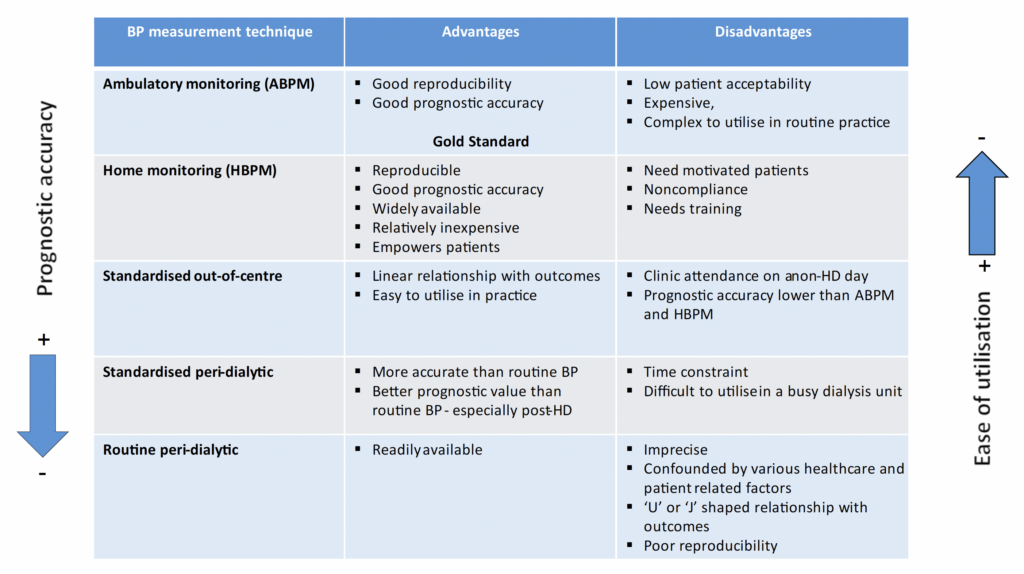
The table below summarises advantages and disadvantages of different BP readings available for dialysis patients.
Relative merits and demerits of different BP measurement techniques in haemodialysis patients